



Planning the Everest Base Camp Trek? One of the most common and first question trekkers ask is, “How high is Everest Base Camp?” The ‘Everest Base Camp sits at 5,364 meters (17,598 feet) above sea level, which is one of the world’s highest and most popular trekking destination. That is the South Base Camp in Nepal, the one most trekkers are heading to. The North Base Camp in Tibet sits lower, at 5,150 meters (16,900 feet). This places it in the high-altitude zone where oxygen levels are roughly half of what they are at sea level, requiring careful acclimatization for trekkers.
Because there are multiple routes and two different base camps, the height varies depending on the specific location and side of the mountain:
Everest Base Camp Height and Elevations Comparison
- South Base Camp (Nepal): 5,364 meters (17,598 feet) the popular trekking route starting from Lukla.
- North Base Camp (Tibet): 5,150 meters (16,900 feet) the Tibetan side, which is accessible by road.
Those two numbers answer the most common question cleanly. But they only start the story. The elevation profile of the EBC trek, what happens to your body at that altitude, where Kala Patthar fits in, and why base camp may soon be moved to lower ground, all of that matters before you lace up your boots. This guide covers all of it:
How High Is Everest Base Camp?
‘Everest Base Camp height: 5,364 meters (17,598 feet) above sea level.’
This is the South Base Camp in Nepal’s Khumbu region. It sits on the Khumbu Glacier, and the EBC height is measured from sea level, not from the valley floor, which adds to its scale. Every trekker who walks the classic route from Lukla is heading here.
At 5,364 meters, you are standing 3.3 miles above sea level. That is higher than the summit of Mont Blanc, the tallest peak in the Alps. It is higher than any road in the world. And there is still more than 3,484 vertical meters of mountain above you before you reach the Everest summit.
The EBC height is not a recent measurement. It has been consistent across multiple survey sources, confirmed by the Survey of India and the Nepal Survey Department, and it is the figure used by UNESCO, the Nepalese government, and every major trekking authority.
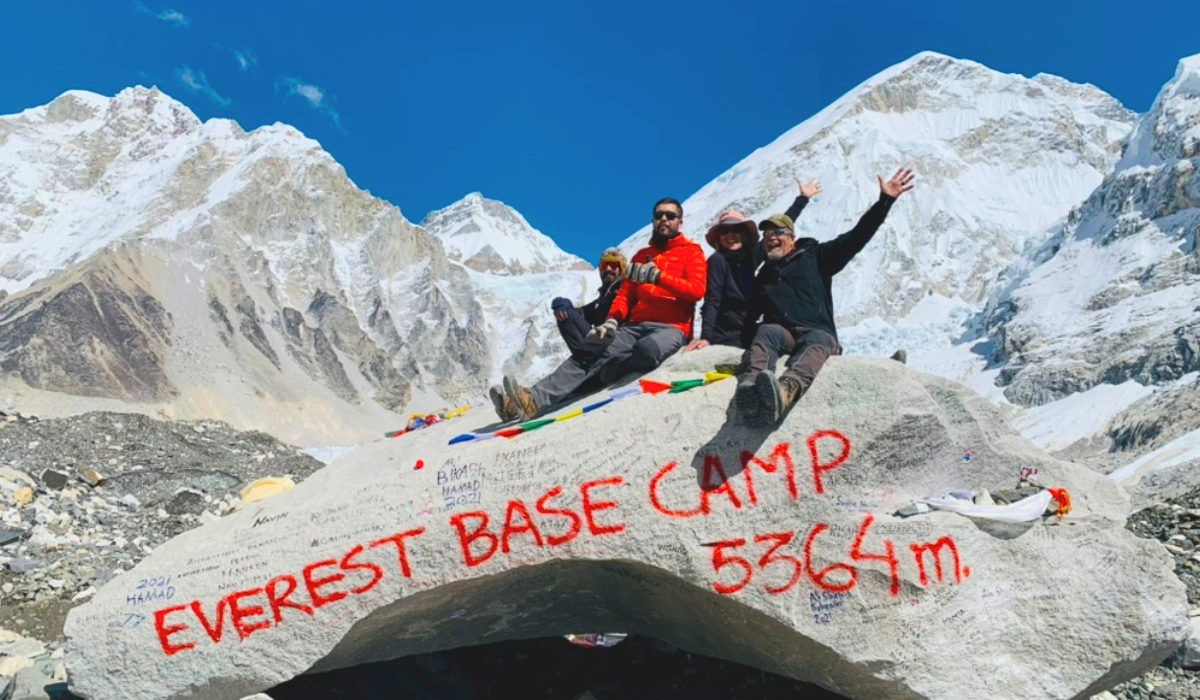
South vs North Everest Base Camp Height: Altitude Comparison
Mount Everest has two base camps. They sit on opposite sides of the mountain, serve different climbing routes, and stand at different elevations. South Base Camp is in Nepal at an altitude of 5,364 metres (17,598 ft), while North Base Camp is in Tibet.
| Base Camp | Location | Altitude (Meters) | Altitude (Feet) | Access Method |
| South Base Camp | Nepal, Khumbu region | 5,364m | 17,598 ft | Trek from Lukla or helicopter |
| North Base Camp | Tibet, China | 5,150m | 16,900 ft | Driveable via road from China National Highway 318 |
The South Base Camp is higher. It sits 214 meters above the Tibetan camp. The reason is geography. The southern approach climbs through the Khumbu valley, a deep glacial gorge. The northern Tibetan plateau allows vehicles to drive much closer to the mountain. The North Base Camp is accessed by vehicle through a 100 km road, with tourists taking horse-drawn carriages or small buses for the last stretch of gravel road to a marked hill at 5,200 metres above sea level.
There is one important acclimatization difference here. The Nepal side’s multi-day trek lets your body adapt gradually. The Tibet side’s road access means you can reach 5,150 meters in a vehicle within hours, which raises altitude sickness risk through rapid ascent. When people search “Everest Base Camp height” or “EBC altitude,” they almost always mean the South Camp in Nepal. This guide focuses on that one.
Is Everest Base Camp the Highest Point on the EBC Trek?
No. It is not. This surprises many trekkers. The trek is named after EBC. But the highest altitude you reach on the standard itinerary is not at base camp.
Kala Patthar is higher
Most trekkers visit Kala Patthar the morning after reaching Gorak Shep, before walking down to base camp itself. The Kala Patthar viewpoint sits at 5,545 meters (18,192 feet). The true rocky summit of Kala Patthar stands at 5,644 meters (18,519 feet), making it higher than Everest Base Camp itself.
This creates real confusion online. Some sources cite 5,545m, others say 5,644m, and a few give a range. Here is the distinction most articles miss:
| Location | Altitude | What It Is |
| Kala Patthar standard viewpoint | 5,545m (18,192 ft) | Where most trekkers stop for sunrise photos |
| Kala Patthar true rocky summit | 5,644m (18,519 ft) | The actual peak, requires a short additional scramble |
| Everest Base Camp | 5,364m (17,598 ft) | The trekking destination on the Khumbu Glacier |
So the EBC height is 5,364m. But the maximum altitude you will reach on the trek, if you include Kala Patthar, is 5,545m or up to 5,644m depending on how far up the summit you climb.
Why go to Kala Patthar at all? Because you cannot actually see Mount Everest’s summit from Everest Base Camp. The Khumbu Icefall and surrounding ridges block the view. Kala Patthar is the best vantage point of the region, offering a 360-degree panoramic view of the soaring peaks and the stunning outlook of Mount Everest’s summit. Known as the Black Rock, it is the highest place one can visit without any special permit. Skipping it means missing the photograph the trek is famous for.
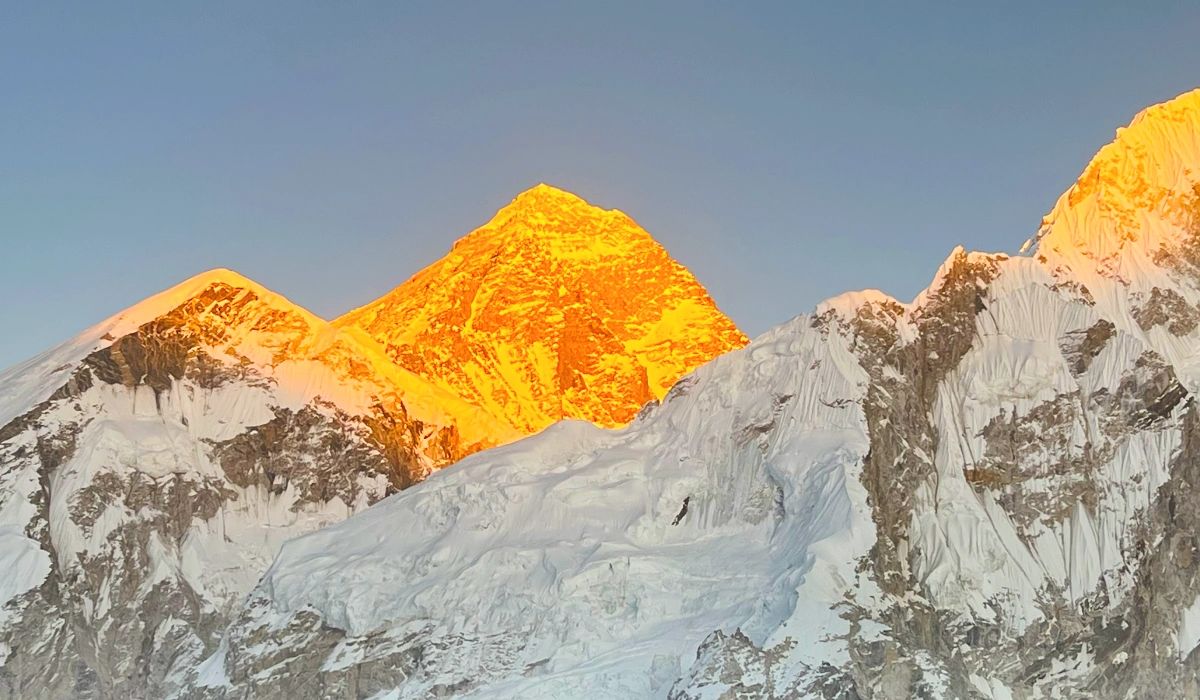
Everest Base Camp Height vs Mount Everest Summit
The numbers put the scale in perspective.
| Location | Elevation (Meters) | Elevation (Feet) |
| Kathmandu | 1,400m | 4,593 ft |
| Lukla airport (trek start) | 2,860m | 9,383 ft |
| Namche Bazaar | 3,440m | 11,286 ft |
| Tengboche | 3,860m | 12,664 ft |
| Dingboche | 4,410m | 14,468 ft |
| Lobuche | 4,910m | 16,109 ft |
| Gorak Shep | 5,180m | 16,990 ft |
| Everest Base Camp | 5,364m | 17,598 ft |
| Kala Patthar viewpoint | 5,545m | 18,192 ft |
| Kala Patthar summit | 5,644m | 18,519 ft |
| Camp 1 (Everest climbers) | 6,065m | 19,900 ft |
| Camp 2 (Advanced Base Camp) | 6,400m | 21,000 ft |
| Camp 3 | 7,162m | 23,497 ft |
| Camp 4 (the Death Zone) | 7,925m | 26,000 ft |
| Mount Everest Summit | 8,848.86m | 29,031.7 ft |
Everest Base Camp Height at 5,364m represents 60.6% of the summit’s elevation. The remaining vertical distance of 3,485 meters to the summit requires technical mountaineering, supplemental oxygen, multiple high-altitude camps, and weeks of additional acclimatization. Base camp marks where trekking ends and mountaineering begins.
Everest Base Camp Trek Elevation Profile: Day by Day
Understanding the altitude gain by day is critical for planning your acclimatization. Move too fast and altitude sickness becomes a real risk. The standard 12 to 16-day itinerary is specifically designed to let your body adapt gradually.
| Day | Route | End Elevation | Elevation Gain / Loss |
| Day 1 | Kathmandu (fly or drive to Lukla) | 2,860m (9,383 ft) | Start |
| Day 2 | Lukla to Phakding | 2,610m (8,563 ft) | -250m |
| Day 3 | Phakding to Namche Bazaar | 3,440m (11,286 ft) | +830m |
| Day 4 | Acclimatization at Namche (hike to Everest View Hotel 3,880m) | 3,440m | +440m up, return |
| Day 5 | Namche to Tengboche | 3,860m (12,664 ft) | +420m |
| Day 6 | Tengboche to Dingboche | 4,410m (14,468 ft) | +550m |
| Day 7 | Acclimatization at Dingboche (hike to Nangkartshang 5,083m) | 4,410m | +673m up, return |
| Day 8 | Dingboche to Lobuche | 4,910m (16,109 ft) | +500m |
| Day 9 | Lobuche to Gorak Shep; hike to EBC | 5,164m (16,942 ft) sleep | +454m to EBC, return to Gorak Shep |
| Day 10 | Gorak Shep to Kala Patthar; descend to Pheriche | 4,210m (13,812 ft) | +381m to KP, then -1,335m descent |
| Day 11 | Pheriche to Namche | 3,440m (11,286 ft) | -770m |
| Day 12 | Namche to Lukla | 2,860m (9,383 ft) | -580m |
| Day 13 | Fly Lukla to Kathmandu | 1,400m (4,593 ft) | -1,460m |
Two points from this profile worth holding onto. First, the descent from Kala Patthar to Pheriche on Day 10 drops over 1,300 meters in a single day. Your knees feel it. Second, starting from Lukla to Everest Base Camp, the total ascent is around 2,524 meters (8,280 feet). Including the Kala Patthar viewpoint, the maximum gain from Lukla is roughly 2,685 meters.

Everest Base Camp Trek – 14 Days
Everest Base Camp Trek is an iconic journey that follows in the footsteps of legendary mountaineers Sir Edmund Hillary and Tenzing Norgay Sherpa. It is done in eastern Nepal within the internationally recognized...
 14 Days
 Difficult
US$ 1440
Why EBC Altitude Matters: Oxygen at 5,364 Meters
The altitude of Everest Base Camp is not an abstract number. It has a direct physiological effect on every person who reaches it.
At 5,364 meters, the atmospheric pressure has dropped to roughly half of what it is at sea level. Base Camp has roughly 50% of the oxygen found at sea level. Your lungs pull in the same volume of air with each breath. But each breath contains approximately 50 percent fewer oxygen molecules than it would at sea level. Your body does not get what it expects.
This is why the EBC trek is designed with rest days at Namche Bazaar (3,440m) and Dingboche (4,410m). The ascent is deliberately slow. The “climb high, sleep low” principle runs throughout. Several climbers make short treks to altitude sites, then return to camp to sleep at altitude, all in the “climb high, sleep low” philosophy. Your body produces more red blood cells in response to reduced oxygen. Over days, your blood becomes better at carrying whatever oxygen is available.
Skip the acclimatization days and this process does not happen properly. That is when altitude sickness arrives.
Technically, 5,364m falls into the “high altitude” category, which runs from 3,500 to 5,500 meters. “Extreme altitude” begins above 5,500m. However, 5,364m sits at the upper edge of high altitude where approximately 50% oxygen remains available and altitude sickness can affect anyone regardless of fitness or experience.
Altitude Sickness at Everest Base Camp
Altitude sickness, or Acute Mountain Sickness (AMS), affects a significant percentage of EBC trekkers. Even well-prepared, fit individuals get it. Fitness does not determine susceptibility. Prior altitude experience helps, but nothing fully guarantees acclimatization.
Common AMS symptoms:
- Persistent headache that does not respond to paracetamol
- Nausea and vomiting
- Dizziness and loss of balance
- Fatigue out of proportion to the effort
- Loss of appetite
- Difficulty sleeping
These symptoms typically appear when ascending too quickly above 3,000 meters. They are your body’s signal that it cannot keep up with the altitude gain.
Serious altitude illness:
If AMS symptoms are ignored and you continue ascending, two life-threatening conditions can develop.
High Altitude Pulmonary Edema (HAPE) causes fluid to accumulate in the lungs. Breathing becomes extremely difficult even at rest. Lips and fingertips may turn blue. HAPE requires immediate descent and medical treatment.
High Altitude Cerebral Edema (HACE) causes the brain to swell. Confusion, inability to walk in a straight line, severe headache, and eventually loss of consciousness follow. HACE is a medical emergency.
Both HAPE and HACE are rare when trekkers follow a properly paced itinerary with licensed guides who know the symptoms. Both can be fatal when ignored.
Prevention:
First, beware of health and safety tips about high altitude trekking in Nepal. Ascend gradually with proper acclimatization. Stay hydrated, drinking at least 3 litres of water. Be aware of early symptoms of altitude sickness to avoid worsening the situation. Give the body proper rest, so adequate sleep is essential at higher altitudes. Avoid alcoholic drinks and smoking. Use medication if necessary. Descending to lower altitude helps in tackling altitude sickness.
The only reliable treatment for serious altitude illness is immediate descent. No amount of water, rest, or medication replaces lower altitude.
Acclimatization on the EBC Trek: The Basics
The standard EBC trek itinerary builds acclimatization in at two points. Namche Bazaar (3,440m) on Day 4 and Dingboche (4,410m) on Day 7 are the designated rest days. Both include active hikes to higher altitude during the day, followed by sleeping at the lower camp elevation.
The Namche acclimatization day typically involves hiking to the Everest View Hotel at 3,880m, giving you the first clear views of Everest, Lhotse, and Ama Dablam in good weather. The Dingboche day hike reaches 5,083 meters at Nangkartshang Peak, the highest pre-base-camp acclimatization point on the route.
By the time you reach Gorak Shep at 5,164 meters and walk to EBC at 5,364 meters, your blood oxygen saturation should be reading reasonably well on a pulse oximeter. A good guide carries one and checks readings twice daily above 4,000 meters. It is one of the first questions to ask any trekking agency before booking.
The Khumbu Glacier: Why EBC Sits Where It Does
This is the angle that almost no trekking article covers, and it is worth knowing.
Everest Base Camp does not sit on solid ground. It sits on the Khumbu Glacier. With elevations of 4,900 m at its terminus to 7,600 m at its source, it is the world’s highest glacier. Glaciers move. They also melt.
The Khumbu Glacier flows downhill at a rate of roughly one meter per day at its fastest points. The glacier’s surface, where tents and base camp structures sit during climbing season, changes position from year to year. Combined with glacial melt that has accelerated significantly since the 1990s, the surface elevation at base camp fluctuates slightly.
This is why some sources cite 5,364 meters and others say 5,356 meters or 5,380 meters. The Everest Base Camp elevation varies slightly year to year as the Khumbu Glacier moves and shifts. However, the established measurement of 5,364 meters remains the standard reference point used by trekking agencies, mountaineers, and navigation systems.
Is Everest Base Camp Being Moved? The 2026 Relocation Story
Here is the development almost no other elevation guide mentions, and it directly affects future trekkers!
On 17 June 2022, it was announced that base camp would be moved 200 to 400 metres lower, since the Khumbu
Glacier, on which the campsite is located, is rapidly melting and thinning out, making it unsafe for trekkers. The decision came from the Nepal government and the Sagarmatha Pollution Control Committee, responding to meltwater streams forming under the camp and increasing crevasse activity where climbers sleep.
The relocation has not yet fully happened, and the timeline remains under discussion. But the direction is clear: the official EBC elevation figure could change within this decade as the camp shifts to more stable ground.
There was also a smaller controversy at the site itself. In March 2024, a new signboard at Everest Base Camp was unveiled, sparking strong reactions from trekkers and mountaineers who preferred a graffiti-coated rock that had long been considered the base of the climb. Local authorities removed the signboard in May 2024, speculated to be due to unpopularity. For trekkers, this means the iconic photo spot at base camp has been in flux. The painted rock remains the symbolic marker most trekkers photograph.
5,364 Meters to Feet: EBC Height Conversion Table
Several searches specifically look for the meters-to-feet conversion. Here is the complete reference.
| Altitude (Meters) | Altitude (Feet) | Location |
| 5,364m | 17,598 ft | Everest Base Camp (South, Nepal) |
| 5,150m | 16,900 ft | Everest Base Camp (North, Tibet) |
| 5,545m | 18,192 ft | Kala Patthar viewpoint |
| 5,644m | 18,519 ft | Kala Patthar true summit |
| 5,164m | 16,942 ft | Gorak Shep |
| 4,910m | 16,109 ft | Lobuche |
| 4,410m | 14,468 ft | Dingboche |
| 3,860m | 12,664 ft | Tengboche |
| 3,440m | 11,286 ft | Namche Bazaar |
| 2,860m | 9,383 ft | Lukla (trek start) |
| 8,848.86m | 29,031.7 ft | Mount Everest Summit |
The calculation is straightforward. One meter equals 3.28084 feet. So 5,364 meters multiplied by 3.28084 gives 17,598.4 feet, rounded to 17,598. The 5364 meters to feet conversion equals exactly 17,598 feet. The figures used across all official sources are consistent on this.

Everest Three Passes Trek – 17 Days
Everest Three Passes Trek is an adventurous journey that crosses three legendary passes in the Everest region. This is the most extreme adventure that challenges your endurance level and offers a life-changing experience....
17 Days
Challenging
US$ 1650
How EBC Compares to Other Famous High Places
Putting 5,364 meters next to other landmarks people recognize makes the scale concrete.
| Place | Elevation | How It Compares to EBC |
| Everest Base Camp | 5,364m | Reference point |
| Mont Blanc (highest Alps peak) | 4,808m | EBC is 556m higher |
| Kilimanjaro summit | 5,895m | 531m higher than EBC |
| La Rinconada, Peru (highest human settlement) | 5,100m | EBC is 264m higher |
| Everest Camp 2 (Advanced Base Camp) | 6,400m | 1,036m higher than EBC |
| Mount Everest summit | 8,848.86m | 3,484m higher than EBC |
You are standing higher at Everest Base Camp than at the top of Mont Blanc, and higher than the highest place humans permanently live. Yet you are still only 60 percent of the way up Everest.
Everest Base Camp Trek: Frequently Asked Questions
How high is Everest Base Camp?
The South Everest Base Camp in Nepal sits at 5,364 meters (17,598 feet) above sea level. The North Base Camp in Tibet sits at 5,150 meters (16,900 feet). Most trekkers use “Everest Base Camp” to refer to the South Camp in Nepal.
What is the elevation of Everest Base Camp in feet?
17,598 feet above sea level, equivalent to 5,364 meters.
How high is Mount Everest Base Camp in meters?
Mount Everest Base Camp sits at an official altitude of 5,364 meters above sea level on the Nepal side. The North Base Camp in Tibet is 5,150 meters.
Is Everest Base Camp the highest point on the EBC trek?
No. Kala Patthar is higher. The standard viewpoint where most trekkers stop is at 5,545 meters (18,192 feet). The true rocky summit of Kala Patthar reaches 5,644 meters (18,519 feet).
What is the altitude of Everest Base Camp compared to the summit?
EBC sits at 5,364 meters. The Everest summit is 8,848.86 meters. There is a vertical difference of approximately 3,484 meters between base camp and the top of the mountain. EBC represents about 60.6% of the summit’s total height.
How much elevation gain is there on the EBC trek?
From Lukla at 2,860 meters to EBC at 5,364 meters, the total ascent is roughly 2,524 meters. Including the Kala Patthar viewpoint, the maximum gain from Lukla is about 2,685 meters.
What altitude is Everest Base Camp considered dangerous?
5,364 meters is high altitude. Above 5,000 meters, oxygen availability is significantly reduced and altitude sickness risk rises sharply. Above 8,000 meters (the Death Zone), the human body cannot acclimatize and begins to deteriorate even with supplemental oxygen.
Why is Everest Base Camp on a glacier?
EBC sits on the Khumbu Glacier because it serves as the staging ground at the foot of the Khumbu Icefall. Establishing camp here gives climbers direct access to the ice routes required to begin the ascent toward the summit via the South Col route.
What is the EBC elevation in simple terms?
5,364 meters is about 5.3 kilometers straight up from sea level. It is roughly 60% of Mount Everest’s total height, higher than Mont Blanc, and the air holds about half the oxygen available at sea level. It is a staging point, not the summit, and you cannot clearly see Everest’s peak from base camp itself.
How high is base camp at Everest compared to other famous places?
EBC at 5,364 meters is higher than Mont Blanc (4,808m) and higher than La Rinconada in Peru (5,100m), the world’s highest permanent human settlement. Kilimanjaro’s summit (5,895m) is slightly higher than EBC.
What is the Mt Everest base camp elevation for the North side?
The North Base Camp in Tibet sits at approximately 5,150 meters (16,900 feet). Some markers place it slightly higher around 5,200 meters. It is accessible by paved road, unlike the Nepal side. For climbers continuing past it, the North Advanced Base Camp sits at about 6,400 meters.
Is Everest Base Camp being moved?
Yes, this is under active discussion. In June 2022, Nepali authorities announced plans to move base camp 200 to 400 meters lower due to rapid Khumbu Glacier melting making the current site unsafe. The relocation timeline remains under review, but the official elevation figure could change later this decade.
Planning Your EBC Trek with Explore Vision Nepal
The elevation profile of the EBC trek is fixed. The difference between a successful summit of Kala Patthar and a difficult evacuation at Dingboche comes down to how that profile is managed: how the acclimatization days are used, how closely a guide monitors oxygen saturation, and how quickly the team responds when someone’s readings drop.
Explore Vision Nepal has guided trekkers through the Khumbu region with a safety-first approach. Our guides carry pulse oximeters on every high-altitude trek. We log readings twice daily above 4,000 meters. We know the descent protocol for AMS symptoms. And we have done this route enough times to know when to slow down before a trekker knows they need to.
If you are planning your EBC trek for the 2026 autumn season (September to November), departure dates are filling. The spring 2027 season (March to May) is now open for booking.