

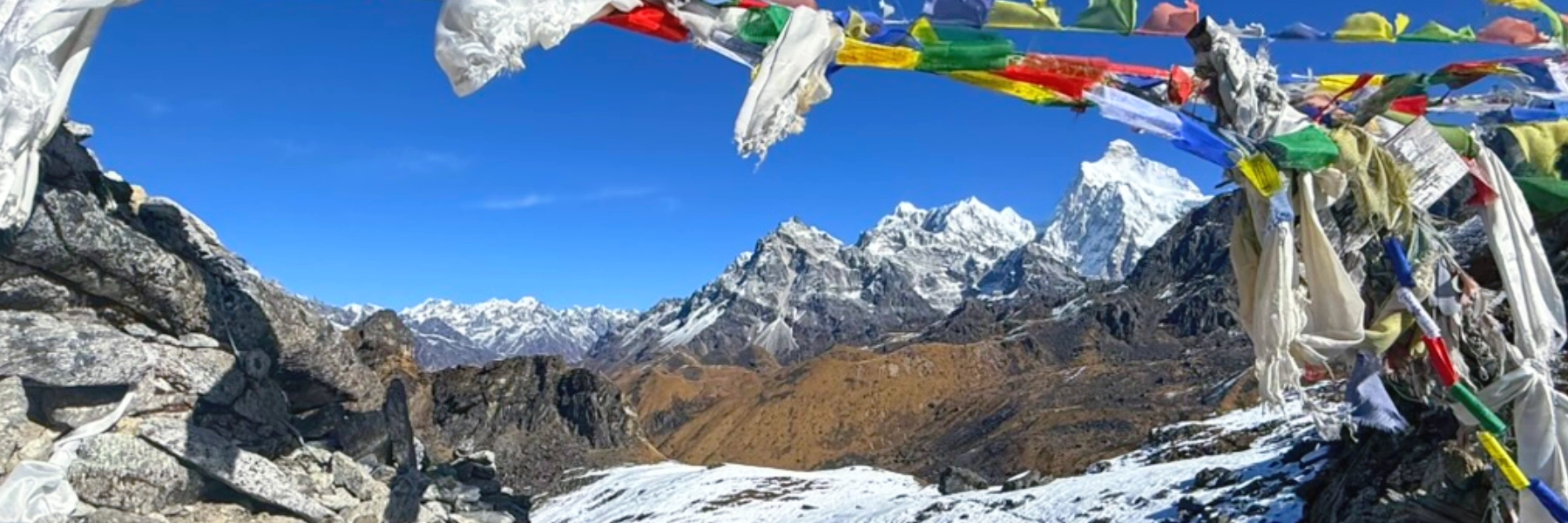

Mount Kanchenjunga: Five Treasures of the Sacred Snow, as the name suggests, is more than a snow peak. With an altitude of 8,586m and a historical footprint dating back to the 1800s, Kanchenjunga stands as the third-highest mountain in the world!
And did you know? For decades, explorers and surveyors actually believed it was the highest peak on earth until measurements placed Everest above it. But that shift in ranking never reduced its powerful structure and spiritual representation in the world. The mountain is still considered the most sacred and iconic peak in the eastern Himalayas.
Rising along the border of Nepal, Sikkim, and India, Mount Kanchenjunga is surrounded by diverse landscapes, indigenous Himalayan settlements, and hidden valleys untouched by mass tourism. It has been carrying the centuries-old stories and traditions along.
To know everything about what Mount Kanchenjunga truly represents, in this guide, you learn about the major aspects of the mountain: meaning and formation of the name, early exploration history, Indigenous people: The Lepcha, the three valleys of Kanchenjunga, remote villages scattered along the trail, and the experience of Kanchenjunga Circuit Trek from the beginning, along with its itinerary and what to expect in 2026/2027.
Formation of the name Kanchenjunga: In Tibetan and Lepcha Language
In many parts of the Kanchenjunga region, Buddhist communities have their own traditional beliefs. For them, Kanchenjunga has a spiritual and sacred importance. With this, Kanchenjunga is known by different names in different cultural and linguistic traditions, each name reflecting their connection to the mountain.
In Tibetan, the mountain is called Khang-Chhen-Dzonga, which is commonly translated as “The Five Treasures of the Sacred Snows.” According to traditional belief, these five treasures symbolize the essential gifts of life: gold, silver, grain, sacred texts, and medicine. The name frames Kanchenjunga as a powerful source of both spiritual and material protection.
The Lepcha people use a different name entirely. They call it King-tzum-song-bu, meaning “the highest over our head.”
This name expresses a deep relationship between the people and the mountain Kanchenjunga. It is a reminder that Kanchenjunga stands above the land as a guard, closely tied to the identity, memory, and spiritual life of the people who live in its shadow.
To the indigenous people of Kanchenjunga, the mountain remains tied directly to the identity, memory, and spiritual life of everyone living in its shadow.
Start of exploration and mountaineering in Kanchenjunga
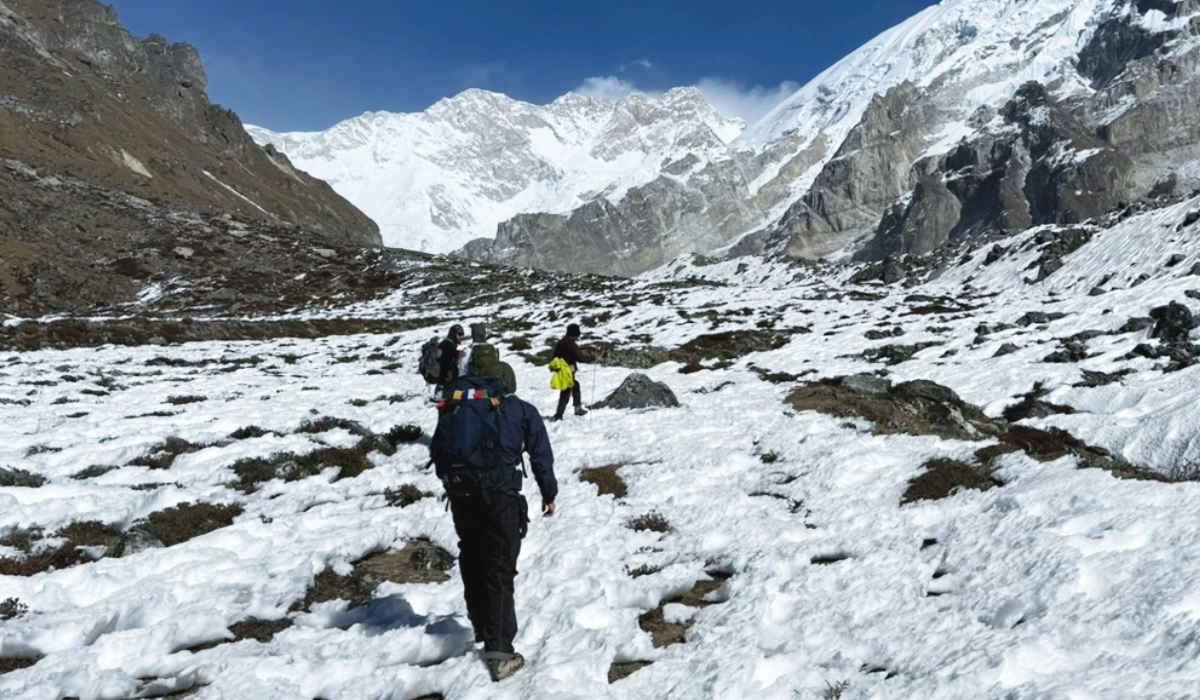
Long before Mount Kanchenjunga was shifted and overshadowed by other popular regions like Everest and Annapurna, explorers and mountaineers were drawn to this remote corner of Nepal. English Botanist J.D Hooker is the first outsider to travel through the Tamor, Gunsa, and Yangma valleys. During the expedition, he documented the glacial moraines as far down as 8,.000 to 10,000 feet. This started the early scientific research related to the Kanchenjunga region.
After that, in 1884, Rinzing Namgyal was the first person recorded to circumambulate the Kanchenjunga. Later, Douglas Freshfield followed the same route in 1899. The journey was via Selele and Khang La passes, which are used in modern days as a trekking route for the Kanchenjunga Circuit Trek. He was also supported by Italian photographer Vittorio Sella and documented significant glacial shrinkage in the Lhonak region.
Continuing, the first summit attempt in 1905 was led by the British Aleister Crowley. However, it only became possible in 1955 with the George and Joe Brown, part of a British expedition led by Charles Evans.
And do you know what the overwhelming part of it is?
The summit was stopped just short of the actual summit, out of respect for local beliefs. Many climbers may still honor the tradition till today. The belief that still exists, that Mount Kanchenjunga is not just a single peak standing, but a deity, protector, and provider of all the local people.
It shows the connection between local mountain people and the Himalayas from way ahead than we think!
The Lepcha: Indigenous people of the Mount Kanchenjunga Basin
There are many stories of migration in the Himalayan regions; however, there are only a few stories of natives to the region. One of them is the stories of the Lepcha people: the indigenous people of Mount Kanchenjunga.
According to tradition, their first ancestors, Fudongthing and Nazong Nu, were formed from the eternal snows of the summit, Kamchenjunga. The Lepcha name for their homeland, Mayel Lyang, refers to a hidden paradise of immortal beings, a place tied closely to the sacred geography of Kanchenjunga. Even the greeting “Aachulay” carries that connection, as it is also understood as a salutation to Kanchenjunga.
Each year, the communities celebrate Chyu Ruum Faar, a festival held to honor Kanchenjunga and the deities believed to live there. If you are lucky and come across the region during the festival, you get to walk through these villages, prayer flags, shrines, local rituals, and everyday acts of respect toward the land, all of which show the spiritual bond.
The Three Valleys around Kanchenjunga: Tamor, Ghunsa, and Yalung
In recent years, as mountain activities are increasing with time, explorers who want to witness the beauty of the world’s third highest mountain, pass through three major river valleys named Tamor, Ghunsa, and Yalung. Tamor Valley on the outer flank, Ghunsa Valley continues to the traditional trading route, and Yalung Valley on the glacial south.
Tamor River Valley: This valley is where traders used to move salt from Tibet down into the warmer hills of Eastern Nepal. Where people were highly engaged in producing grain farms. This is the outer edge of the Kanchenjunga region, where you can find basic livelihood with terraced farmland, rivers, and traditional villages.
Ghunsa River Valley: Continuing north from the Tamor River, the valley is known as Ghunsa. It is the northern route to Kanchenjunga and is also considered the main trekking route these days. It takes you deeper into the Kanchenjunga Conservation Area, guiding trekkers through traditional villages like Ghunsa, Kambachen, and Lhonak before the North Base Camp, Pangpema. This is the essential valley serving for years as an acclimatization stop where trekkers prepare for the high passes.
Yalung River Valley: This is the remote section that approaches the southern slopes of Kanchenjunga. It takes you to the high-altitude zone that leads to Yalung Glacier and the Kanchenjunga South Base Camp, crossing different high passes. The routes in the valley climb from lower villages like Yamphudin through Simbuwa to the glacial valley.
Together, these three valleys form a natural Circuit around Mount Kanchenjunga that is followed these days.
Villages scattered around Mount Kanchenjunga
Yamphudin Village: This village is at the southern entry and sits above the Kabeli River. Here, local families belong to the Limbu community and are rooted in the Kirati tradition. They highly depend on agriculture, such as millet, maize, and cardamom farming, with the morning often smelling of woodsmoke through the village.
Tapethok/Tapetok village: This village is the starting point of the Kanchenjunga Conservation Area, from where the permits for entering the area are checked. It is located near the Tamor River and gives an ambience of a lively stop point. Here, people mostly belong to the Rai and Limbu communities, who manage cardamom farms. This is where the DNPWC monitoring of wildlife and forest use begins.
Gyabla village: It is where the landscape starts to diverge into the alpine roughness. People from the communities of Rai and Sherpa live here, growing potatoes, watching over the livestock. People are rooted in the mix of Kirati and Buddhist traditions here. The homes are decorated with prayer flags and routes with the mani walls.
Ghunsa Village: It is one of the most important settlements around Mount Kanchenjunga. It serves as the main stop in the upper valley for the trekkers. Explorers, trekkers, and visitors. Stop here for the acclimatization. This village is deeply rooted in the Sherpa culture and traditions. There are around 40 teahouses, a lodge, a monastery, and a hydroelectric system in the village. Local people of this village engage in barley farming and Yak herding in their day-to-day life.
Phale: After crossing the village Ghunsa, one of the villages that is settled in Kanchenjunga is Phale. The village is smaller and quieter than Ghunsa, which sits beside the river and almost feels remote. The village is influenced by the Buddhist tradition, and life at Phale revolves around Yak herding, cheese production, and seasonal tourism.
Kampuchen: This village is slightly closer to the mountains and sits around the alpine landscapes. The terrain around here is rougher, and it lies near the glacial zone. There is no permanent settlement in these villages due to the high altitude and migration. The village operates seasonally for the trekkers, with basic lodges and shelter for supporting tourism.
Herders use the area seasonally and migrate to the lower villages at other times. It is tougher to stay here, the area is open closer to glaciers, and windy days. This village is usually used as a rest stop and preparation stop for the trekkers to move forward.
Lhonak Village: This village is near the North Base Camp of Mount Kanchenjunga. There are no vegetations around this village, and it is rocky and icy. This is the last village before the Pangpema (Kanchenjunga North Base Camp). Even in this village, there are no permanent settlements. As the village is close to Mount Kanchenjunga, it is one of the best places to see the Face of Kanchenjunga.
Tseram: This village lies in the Yalung Valley and is surrounded by the rhododendron forests and open meadows. It is a bit warmer than Lhonak village. This village serves as a rest point for the explorers travelling to the South Base Camp of Kanchenjunga. Here you can find monasteries and sacred sites reflecting the strong spiritual traditions of the region.
Ramche: It is a village that lies at a high altitude before the Southern Base Camp of the Kanchenjunga. The terrain here is glacial, with windy weather. Here, the villages serve basic lodge facilities and do not have permanent settlements. You can see the south face of the Kanchenjunga in close-up form from the village.
Olangchun Gola: This village is in the northern part of Mount Kanchenjunga, which is the richest known cultural stop of the route. There are around 50 homes and an old monastery with its Tibetan Sherpa heritage. The settlements are basically wooden, carved with the traditional livelihoods supported by the barley farms, yak herding, and trades.
These are the major villages around Mount Kanchenjunga, where you can see the continuity of daily life around the mountains. And how the traditional roots are kept with honor and respect even in modernized days.
Circling Mount Kanchenjunga: Kanchenjunga Circuit Trek
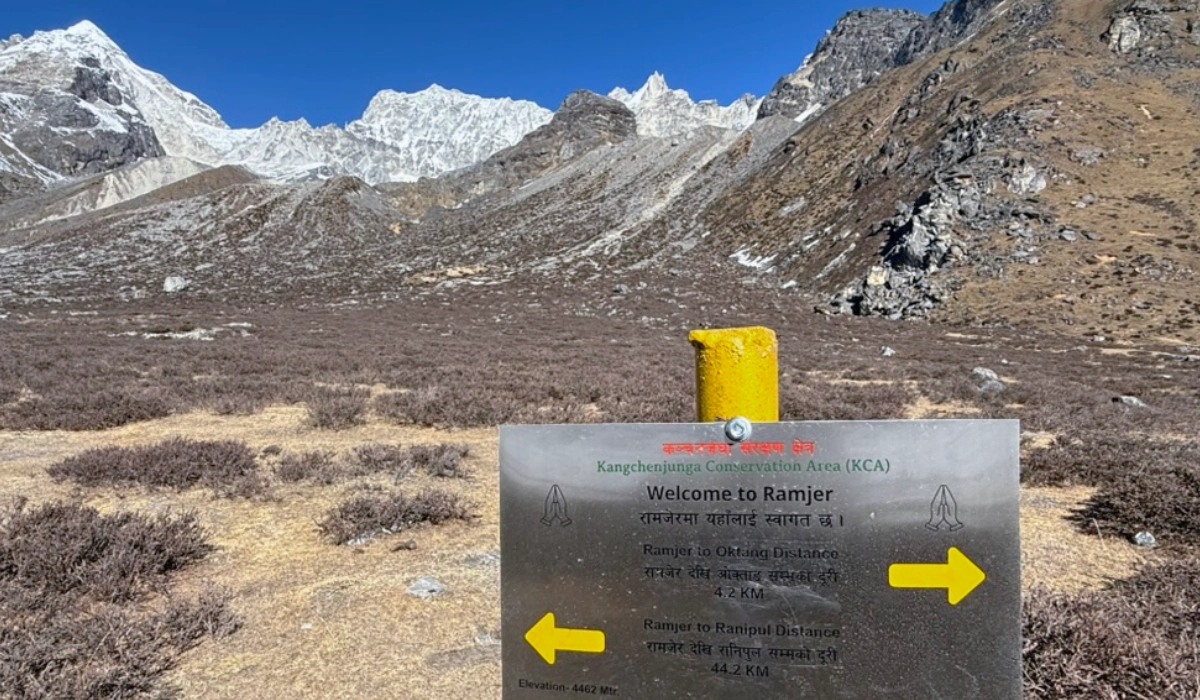
With the continuity of exploration around the Mountain, different ways have been introduced to keep humanity known to Kanchenjunga. One of the major ways it is done in recent years is the journey of the Kanchenjunga Circuit Trek.
This is considered one of the most remote trekking adventures in Nepal. On this trek, you pass through both northern and southern sides of Mt. Kanchenjunga, including the prominent Yalung Kang, through breathtaking Himalayan landscapes!
Following the same traditional route used by the mountaineers and local traders, you pass through the villages of Tapse, Sikhar, Ghunsa, and Phale. It follows changing landscapes from the lower villages through local terraced farmland, dense forests, and green hillside. On this path, you get to see the same livelihood with dependence upon agriculture, animal herding, and seasonal tourism in the region.
Climbing higher, it passes through the yak pastures, mountain passes, and the snowy trails. Overall, this journey in Kanchenjunga is considered the best way to explore the traditional and historic routes. With a combination of cultural immersion into the valley’s traditional village, staying under the influence of local people.
Along with this, you also get to explore the high-altitude mountain passes ranging from 4,100 to 4,800 meters on the trek, reaching up to 5,142m. Making the trek moderate to challenging, while still keeping the raw essence of the Himalayan journey. This journey is best suited for the trekkers and explorers seeking a less-crowded, still-to-be-explored, Himalayan journey grounded in authenticity and conservation even in these modern days.

Kanchenjunga Circuit Trek – 22 Days
Kanchenjunga Circuit Trek is one of the least-traveled treks in eastern Nepal, which borders Sikkim and Tibet. It offers a journey around the world’s third-highest mountain, Mount Kanchenjunga. This adventure explores Kanchenjunga’s North...
 22 Days
 Challenging
US$ 2200
Aspect
Region: Eastern Nepal, Kanchenjunga Conservation Area. The first community-managed protected area of Nepal
Duration: 22 days, completing a round around Mount Kanchenjunga (the world’s third highest mountain in the world)
Max Altitude: 5,142m/16,870ft at Kanchenjunga North Base Camp (Pang Pema)
Distance: 220-240 km on foot (trekking)
Difficulty: Moderate to challenging, do not need technical climbing
Best Seasons: March-May (spring), Oct-Nov (autumn), when the weather is usually more stable, and the mountain views are at their best.
Beginning of the Kanchenjunga Circuit Trek
While the observations continued around the mountain, people living behind its shadows stayed in their daily life within the route we call today “Kanchenjunga Circuit Trek”. These routes were used by local communities in Taplejung for seasonal herding, trade, and migration, moving their yaks and goats, carrying salt and grains.
As Nepal started booming in regions like Annapurna and Everest in the 1980s, there were still a few adventurers and expedition support teams interested in the Kanchenjunga Valley. Then the Nepal government officially announced the area as a conservation zone in 1997, and by the 2000s, basic teahouses and infrastructure began to be built in villages like Gunsa and Tseram.
It was built even if there were only a few trekkers. This proves the warmth and courage of the locals for the continuity of livelihood. Like this, with the increasing growth of tourism in the region, there are slowly more teahouses in the region for seasonal trekkers and explorers.
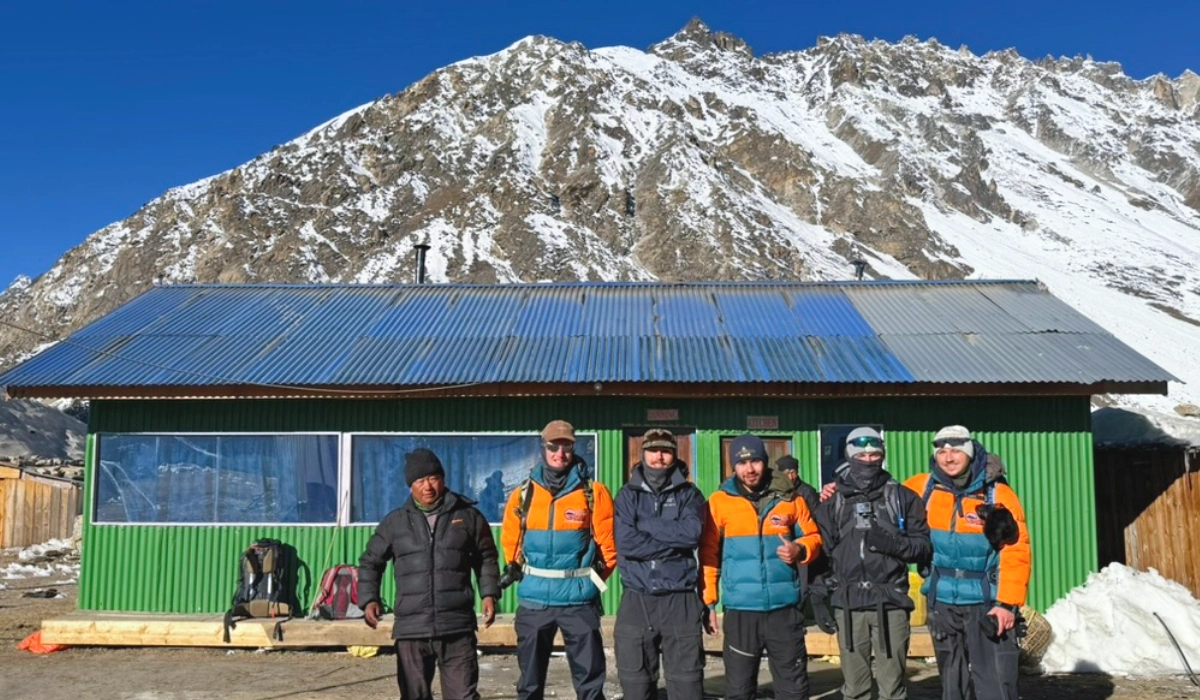
Location: The first community-managed protected area
This journey is done within the Kanchenjunga Conservation Area, which covers 2,035 square kilometers. It was officially established in 1997 and was handed over to the people who actually live there in 2006. That made it the first community-managed protected area of Nepal. Since then, the responsibility of the conservation area is shared among tourism management, preservation, and sustainable use of natural resources.
This means that when you trek here, your presence directly supports local people and helps preserve the environment. It helps you trek responsibly.
Permits required for the KCA -Kanchenjunga Conservation Area
- Restricted Area Permit (RAP)
- Kanchenjunga Conservation Area Permit (KCAP)
- TIMS Card (Trekkers’ Information Management System)
Here is the more details about Kanchemjuunga circuit trek permit and cost.
Important Regulations
- Mandatory Guide: You cannot trek independently; you must hire a licensed guide
- Group Size: Minimum 1 person (solo trekkers are allowed since the March 2026 update in RAP)
- Restricted Zones: Some areas near the border are off-limits; you cannot trek outside your itinerary
- Environmental Rules: Strict waste management and conservation guidelines are applied; while trekking, you must carry your waste and use the public dustbin or use the teahouse dustbins.
People and settlements on the Kanchenjunga trail
Travel through the layers of History, culture, and migration. The villages along the Kanchenjunga Circuit Trail reflect a deep and complex human story shaped by geography, trade routes, and survival in the high Himalayas.
The main groups you’ll encounter on the Kanchenjunga Circuit Trek are:
- Limbu
- Rai
- Tamang
- Gurung
- Magar
- Chhetri
- Sherpa
The earliest people known to live in the Tamor and Ghunsa valleys are likely Magar people. Evidence for this can still be seen in the form of ruined dzongs (fort-like structures) found in the region. Over time, these settlements were replaced and mixed with the Limbu and Rai communities, which we can see during the circuit in the mid-hills and lower valleys.
As the journey takes its steps in higher altitudes beyond Ghunsa, there is more influence of the Sherpa people, Tibetan-origin communities. They are believed to have entered the region through high mountain passes like Jhinsong La and Chapuk La. Continuing exploration through these trails and people keeps the history alive of the Kanchenjunga.
Traditional Livelihood Along the Trails of Mount Kanchenjunga
As you trek through the Kanchenjunga Circuit, you get to experience more than a diverse terrain. You also pass through the remote valleys through traditional villages, where people still depend on herding, farming, trade, and tourism to support their living. As part of this journey, trekkers get to interact and deeply connect with the traditional lives of Kanchenjunga.
While you are on the trail for exploration, on the other hand, you begin to notice that there are fewer young people, and most of the herding and agriculture is done by the older generation. Most of the households have younger family members who leave for education, jobs, or outside life. When you understand this deeply, only then does the journey get more genuine.
So, while you come to Kanchenjunga, you get an exclusive Himalayan experience, as well as you get to witness communities adapting in real time. This gives a greater meaning to your journey as you visit this remote trail, walking through different cultures, and likely each day.
Accommodation and foods available on the Kanchenjunga Circuit
As you trek the Kanchenjunga circuit, you stay mostly in simple teahouses and basic family-run lodges. Rooms are basically twin sharing, with two beds, a mattress, a pillow, and a blanket. When you reach higher and the nights are colder, to avoid the cold, extra blankets are provided. Bathrooms are inside the teahouse territory or indoor. Hot showers, charging, and wifi are only more reliable on bigger stops like Taplejung and Ghunsa.
In the lower villages like Mitlung or Khebang, the lodges are better and more comfortable than in the higher zones for obvious reasons. Higher up, in places like Kambachen or Lhonak, the rooms start to get colder with limited facilities. Near the North Base Camp side, some trekkers stay in very basic huts, and some operators switch to tents when weather or space is overbooked.
Taking notes on the food available on the Kanchenjunga Trail, it is hearty, simple, warm, and home-made. It is perfect serving for long walking days. On the menu, you get common Himalayan trekking meals like dal bhat, along with thukpa, noodles, momo, pasta, Tibetan bread, and basic soups. In some villages of Kanchenjunga, you get to have gundruk and dhindo national food of Nepal, as well.
For drinks, tea, masala tea, ginger-lemon-honey, coffee, and hot chocolate are common in the Kanchenjunga teahouses. When the wind turns cold, and your legs are tired, even a plain bowl of noodle soup can feel surprisingly good.
Major Highlights of the Kanchenjunga Circuit
- The journey introduces both the North Base Camp (Pangpema) and South Base Camp (Oktang). Complete a round around Mount Kanchenjunga. Start from the north face and continue with the south face.
- Remote experience, walking on the historic and forgotten Himalayan trail of Nepal. Where Kanchenjunga shines like a hidden gem rather than an overly commercialized product!
- Walks through the diverse ethnic communities of Limbu, Rai, Tamang, Gurung, Magar, Chhetri, and Sherpa. Participate in their day-to-day activities and explore their unique cultures. See the simple and unified life around Mount Kanchenjunga.
- Witness the close-up faces of the Mount Kanchenjunga from Southern and Northern side. Along with the massif, we see other, less-known mountains like Jannu and Kabru.
- Challenge your endurance level with the high-altitude passes of the Kanchenjunga Circuit: Sele La (Sele Le Pass), Sinion La (Sinion Pass), Mirgin La (Mirgin Pass), Sinelapcha La (Sinelapche Bhanjyang), adding thrill in the journey.
- Experience the rollercoaster landscape, subtropical forests, hills, glaciers, and endless mountains around you.
- Enjoy more potential sightings of rare wildlife like red pandas, snow leopards, Himalayan black bears, and rare bird species.
Kanchenjunga Circuit Trek 22 Days Itinerary
Day 1: Arrival at Tribhuvan International Airport. Meet your trekking team. Transfer to your hotel and check in. Relax, unpack, and rest!
Day 2: Final preparation day before your departure for the trek. On this day, check your essential items for the trek, and do the pre-planning. Take the final briefing from your guide before the Kanchenjunga Circuit journey begins.
Day 3: Take a 50 min flight from Kathmandu to Bhadrapur (1,820m). Then drive to Taplejung by jeep. It takes about 7 to 8 hours to reach. Finally, you reach the Eastern beauty of Nepal.
Day 4: Drive from Taplejung to Sekhathum (1,600m) by jeep. Sekathum is the starting point of the Kanchenjunga Circuit trek.
Day 5: Trek from Sekathum to Amjilosa (2,520m). The trek on foot officially starts on this day. Trails pass through subtropical forests, hills, rivers, and suspension bridges. It is around a 6 -7 hour walk.
Day 6: Trek from Amjilosa to Gyabla (2,730m). The trek continues with a gradual ascent through the rhododendron and bamboo groves. It takes a 5-6-hour hike.
Day 7: Trek from Gyabla to Ghunsa village (3,500m), (a major stop of the Kanchenjunga Circuit). The village has a monastery, yak pastures, and a few small lodges. It is 5-6 hours of walking.
Day 8: Acclimatization rest day in Ghunsa with optional short hikes to higher viewpoints and village exploration. It is necessary to keep the acclimatization day before moving forward to avoid any altitude sickness.
Day 9: Trek from Ghunsa to Kambachen (4,050m). The trail starts to enter the alpine landscape from this day onward.
Day 10: Trek from Kambachen to Lhonak (4,780m). The trail passes through glacial paths with wide fields with thinner air. It is around a 7-hour walk.
Day 11: Trek from Lhonak to Pangpema / Kanchenjunga North Base Camp (5,142m). This is one of the best achievements of the trek. After visiting the base camp, you return to Lhonak before continuing. It is around a 7-8 hour walk to Base Camp and return.
Day 12: Trek from Lhonak back down to Ghunsa (3,500m). Descend to the warmer zone and recover the altitude. This takes around 6 hours.
Day 13: Trek from Ghunsa to Sele Le Base Camp (4,355m). It is the start of your southern circuit towards the high passes of Kanchenjunga. To reach here it takes around 6-7 hours.
Day 14: It is one of the big days of the Kanchenjunga Circuit Trek. This day is dedicated to the high passes of the Kanchenjunga region. Cross Sele La Pass (4,290m), Mirgin La Pass (4,645m), Sinion La (4,650m), and descend to Tseram (3,870m). Also, the longest day of the journey is around 8 hours of trek.
Day 15: Trek from Tseram to Ramche (4,480m) for around 4 hours. This is the shortest part of the trek for rest/acclimatization after the high passes and before the southern Base Camp.
Day 16: Hike to Oktang / Kanchenjunga South Base Camp (4,740m) and return to Tseram. Experience the second Base Camp reach of Kanchenjunga. Completing two Base Camps. Around 6-7 hours trek.
Day 17: Trek from Tseram to Torangden / Tortong (2,995m). Start descending to the warmer valleys and greener hills. It takes around 7 hours to walk.
Day 18: Trek from Torangden to Yamphudin (2,080m). This completes the circuit through Lhimbu villages. It takes around 7 hours.
Day 19: Drive from Yamphudin to Kanyam (1,910m). Passes through tea gardens and rural landscapes. It takes around 7 hours.
Day 20: 2 hours drive from Kanyam to Bhadrapur. After that, return flight to Kathmandu.
Day 21: Extra buffer day in Kathmandu. For rest, souvenir shopping, or handling any flight delays due to unexpected events.
Day 22: Departure day with airport transfer based on your international flight schedule. saying goodbye to Nepal and carrying the memories of Kanchenjunga with you!
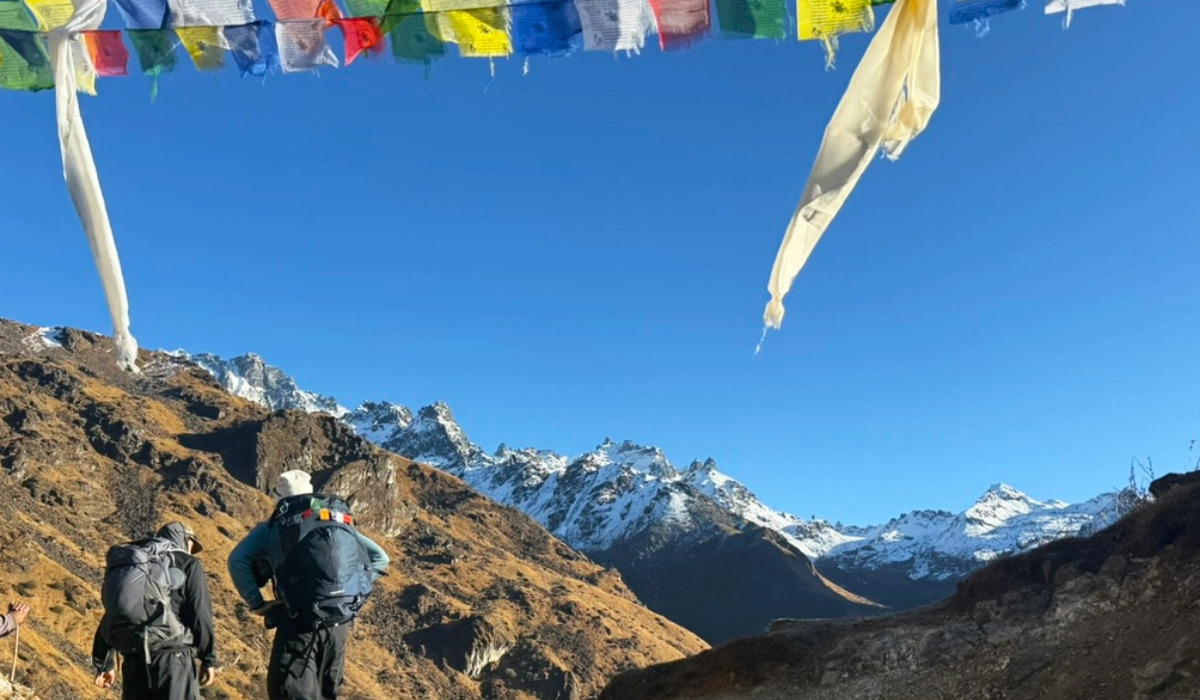
Essential packing list to check for Kanchenjunga Circuit
Clothing
Base Layers:
- 2 Set Thermal
- Innerwear (3-4 sets)
- Trekking T-shirt (3-4, quick dry)
- Trekking pants (2, convertible recommended)
Insulation:
- Fleece jacket or pullover
- Down jacket
- Insulated pants for high altitude
Outer Layers:
- Waterproof and windproof jacket
- Waterproof pants
Accessories:
- Warm hat (wool or fleece)
- Sun hat
- Neck Buff
- Gloves
- Trekking socks (5-6 pairs)
- Gaiters (for snow and mud)
Footwear:
- trekking boots (waterproof, ankle support)
- Camp shoes or sandals
- Sock liners (to prevent blisters)
Equipment
- Trekking poles
- Headlamp with extra batteries
- Sunglasses (UV protected)
- Water bottle
- Daypack
- Stuff sacks or dry bags
Personal Items
- Sunscreen (SPF 50+)
- Lip balm with SPF
- Toiletries (biodegradable soap, toothbrush etc.)
- Quick-dry towel
- Wet wipes
- Hand sanitizer
- Toilet paper
First Aid and Medications
- Personal prescription medications
- Basic first aid supplies
Optional Items
- Camera and extra batteries
- Power bank
- Book or e-reader
- Playing cards
- Journal and pen
- Earplugs
- Portable water filter
Why choose the Kanchenjunga Circuit Trek in 2026/2027?
If you want a trek that still feels raw and special, Kanchenjunga is an ideal choice for 2026/2027. While popular routes in Nepal are crowded in each season, this trail has fewer crowds, less noise, and a strong sense of remote ambience. You walk for hours without having to bump into the crowded groups of trekkers. It is rare to have such a solitary experience with the increasing need for trekking in recent years.
On Kanchenjunga, you find something that many trekkers mention missing these days, that is, authenticity. You pass by the Rai, Limbu, Sherpa, and Tibetan-influenced villages where glimpses of daily life influence the trekking experiences. Along the simple teahouse on the trail, closer to the mountains, the whole region feels truly authentic.
For trekkers who wish to complete a major Himalayan Circuit without the heavy crowds of commercial trekking routes of Nepal, the Kanchenjunga Circuit Trek with Explore Vision Nepal in 2026/2027 is a perfect opportunity to begin with!
Solo Trekkers Access for the circuit journey of Mount Kanchenjunga
Until now, you have learned that the Kanchenjunga Conservation is a highly protected area, as the region covers border areas. It is one of the restricted regions of Nepal. If you have already trekked to one of the regions or are planning to trek as a single/solo trekker, this is one of the most important updates you should know!
As of March 2026, Nepal has officially updated its trekking rules. Solo trekkers are now allowed to obtain a Restricted Area Permit (RAP) for regions like Kanchenjunga. Before 2026, participating in any journeys around Mount Kanchenjunga required at least two trekkers. Solo travelers had to either join a group or find a partner, which often made planning difficult. But as of March 2026, the minimum group requirement has been removed. And now the Kanchenjunga region is open to permits for single explorers.
This change was introduced to make exploration around Mount Kanchenjunga more accessible and to support tourism in remote regions. Planning your journey here as a solo traveler? Don’t miss the latest 2026 RAP permit update, rules, and requirements.
Kanchenjunga Circuit Trek – 22 Days
Kanchenjunga Circuit Trek is one of the least-traveled treks in eastern Nepal, which borders Sikkim and Tibet. It offers a journey around the world’s third-highest mountain, Mount Kanchenjunga. This adventure explores Kanchenjunga’s North...
22 Days
Challenging
US$ 2200