



24x7 Support
+977 9851349597
Unbeatable Holiday Offers - Save Up to 20% on Your Next Adventure!



Annapurna Base Camp Trek – 13 Days
Based on 50 reviews

Duration
13 Days
Trip Difficulty
Moderate
Max Altitude:
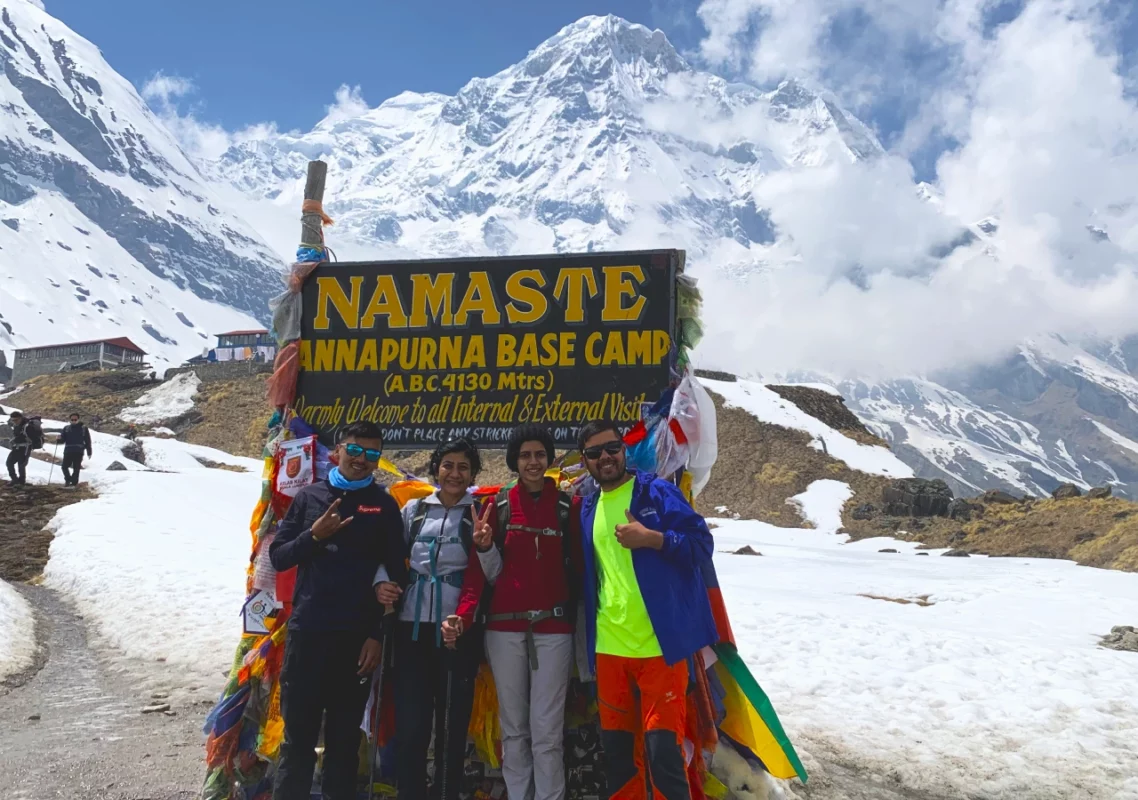
4,130m. / 13,550ft.
Activity
Trekking
Group Size
1-30
Best Season
Autumn, Spring
Meals
Breakfast, Lunch & Dinner
Accommodation
Hotel, Lodge, Guesthouse
Transportation
Private Vehicle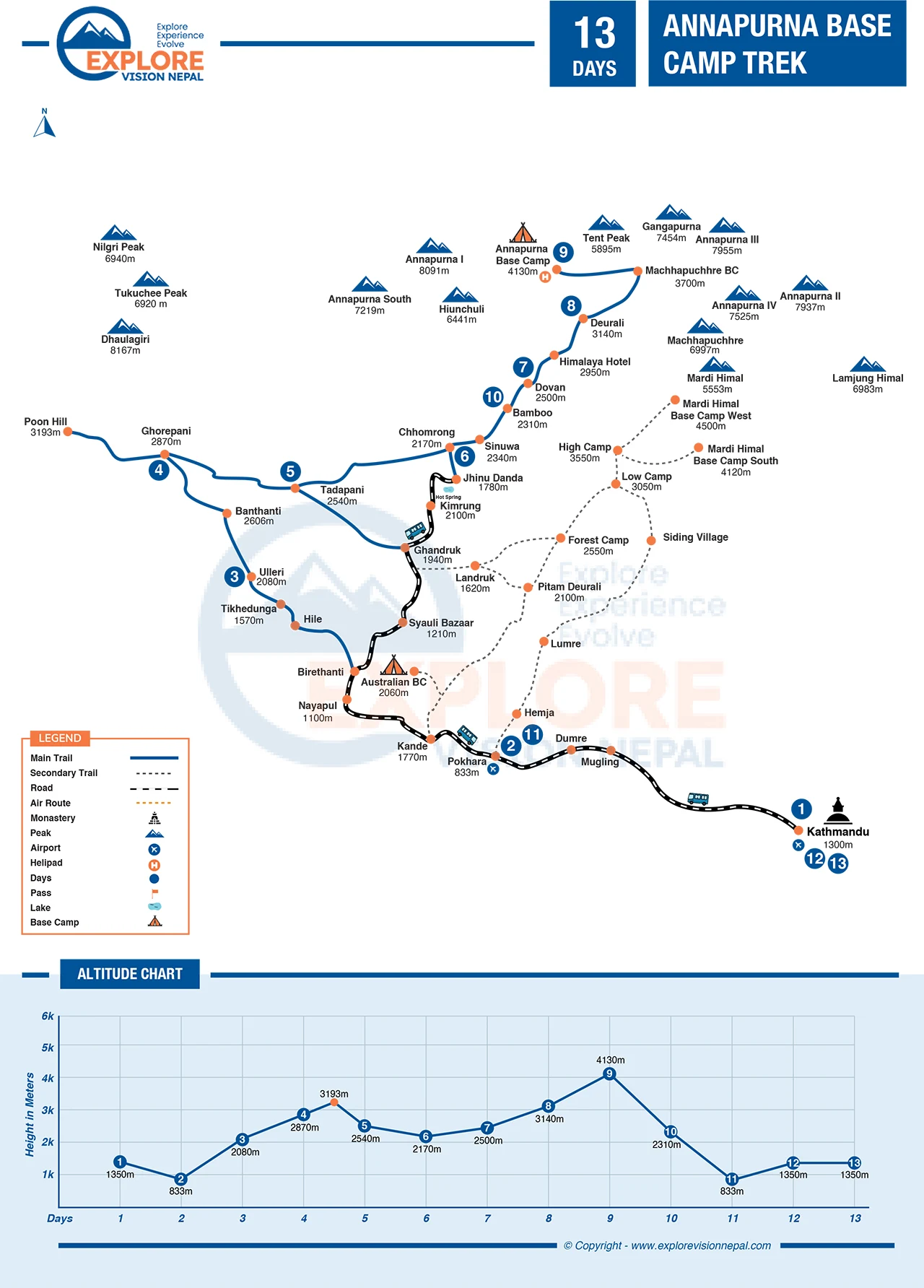
Annapurna Base Camp Trek – 13 Days route map
Overview of Annapurna Base Camp Trek – 13 Days
Annapurna Base Camp Trek is a popular trek in Nepal that explores the southern face of the world’s 10th-highest mountain, the Annapurna massif (8,091m). It offers a blend of natural wonders, cultural exploration, and an adventure through the glacial valleys. You get to experience the typical mountain life of the Annapurna region while enjoying the stunning mountain panoramas.
Annapurna Trek offers breathtaking close-up mountain views of the Annapurna and Fishtail ranges. You get to enjoy stunning sunrise views from the popular points like Poon Hill viewpoint. The stays are done at the villages that warmly welcome and provide an authentic stay. You get to devour the local Nepali Cuisine that is home-cooked and grown.
It starts from village of Birethanti, renowned stone steps of Tikhedhunga to Ulleri, moves to Ghorepani, Poon Hill viewpoint, Tadapani, Chomrong, and Dovan, slowly reaching Alpine landscapes. Then continue through Deurali village, stop at the magical Machhapuchhre Base Camp (MBC, 3700m), and reach Annapurna Base Camp (ABC, 4130m). Walking involves steep stone stairs, cross suspension bridges, rivers, and alpine paths. The journey ends with the perfect warm hot spring at Jhinu Dada, providing an overall wonderful experience from the beginning to the end.
This trek is ideal for trekkers who love exploring mountain trails, diverse culture, and are eager to learn about Himalayan life. Join our well-structured itinerary of the Annapurna Base Camp Trek and get the fullest trek experience!
Annapurna Base Camp Trek’s Difficulty
The Annapurna Base Camp Trek is moderate on the difficulty scale. While it does not demand any technical or advanced skills, it is physically challenging. The trail consists of stone stairs, gradual ascents, terraced fields, and forest paths. The frequent ups and downs along the trail can add strain to the knees, especially when walking on the stairs.
Likewise, the trek’s highest elevation is 4,130 meters at the base camp itself. At this altitude, there is a mild possibility of Acute Mountain Sickness (AMS). However, the risk is lower than on the classic Everest Base Camp trek, which reaches 5,364 meters. Therefore, this trek is often recommended for first time high-altitude trekkers who are looking for a gradual introduction to altitude.
The Annapurna Base Camp Trek involves 5 to 7 hours of walking per day with constant ascent and descent. However, the trek has easy accessibility which typically begins with a short, picturesque ride from Pokhara. Along the way, the accommodation consists of both teahouses and high-end lodges, with the luxury lodges being more available till Sinuwa. After that, it is limited to basic teahouses or guesthouses.
Overall, the trek balances moderate physical demands with stunning scenery and accessible trails and teahouses, making it ideal for those new to high-altitude trekking.
What Are The Unique Factors of The Annapurna Base Camp Trek?
The Annapurna Base Camp Trek takes you to the majestic foothills of the world’s tenth-tallest peak, offering breathtaking panoramic views of the Annapurna range. Annapurna I, Machapuchare (Fishtail), Annapurna South, Hiunchuli, Annapurna III, Gangapurna surround trekkers at the base camp.
The Annapurna Base Camp Trek, despite being shorter than Kanchenjunga and EBC, boasts a diverse landscape. In the early part of the trek, the landscapes vary from subtropical forests of rhododendron, oak, and fern to terraced farmlands. Then it stretches to high-alpine terrain with narrow river gorges and dense bamboo forests.
Moving to the higher regions, you walk surrounded by glacial moraines and ice and rock walls. Furthermore, while descending from the base camp, along the Modi Khola (Modi River), you reach a natural hot spring near Jhinu Danda. It is perfect to relax and soothe your muscles after days of strenuous walking.
The trek takes place in the Annapurna Conservation Area Project (ACAP). It inhabits wide ranges of ecosystems, which provides trekkers an opportunity to explore unique flora and fauna. Wildlife like Himalayan langurs, musk deer, colourful pheasants, and snow leopards reside in this protected area. Similarly, plants like Sal, Chestnut, Oak, Bamboo, Fern, Pine, and Juniper are abundant.
These extraordinary transitions between the landscapes, featuring a ring of majestic mountains, rich biodiversity, and stunning scenic views, are the key highlights of the journey to the Annapurna Base Camp.
Local People And Cultural Practices of The ABC Trek Region
The ABC trek in Nepal is a wonderful opportunity to soak in the ancient cultures of the ethnic groups of Gurung and Magar, inhabiting the area. The Gurungs are primarily found in the Ghandruk and Chhomrong villages. Likewise, the Magars occupy the majority of the lower areas, Ulleri and Ghorepani. During festivals or celebrations, trekkers get to experience traditional music and dances such as Sorathi, Maruni, and Ghatu.
The locals of Annapurna base camp trek region’sok mostly engage in farming, weaving, and animal husbandry. Most of them herd livestock like yaks, sheep, cows, and goats. Additionally, they engage in farming crops such as maize, millet, barley, wheat, and potatoes. Hand-woven blankets and rugs made from sheep and yak wool are sold in marketplaces. This provides financial support to their families.
Some of the most common festivals celebrated here are Lhosar and Maghe Sankranti. Lhosar is the Tibetan New Year celebrated by the Gurung community. You can see them in their traditional dresses and performing “rodhi.” Maghe Sankranti falls in January. It marks the transition of the sun into the zodiac sign of Capricorn (Makar), signaling warmer days and longer daylight. On this day, people indulge in boiled sweet potatoes, yams, and treats made from jaggery and sesame seeds.
Accommodation along the ABC Trail
The lodging facility along the route mainly consists of Teahouses or Guesthouses. In the lower regions, you can find comfortable rooms with attached bathrooms. Likewise, there are high-end lodges around Ghorepani, Ghandruk, Dhampus and Landruk. They often provide electric heaters with private bathrooms and premium meals. Up to Chomrong, you can find upscale amenities. As you march towards upper places of the route, “luxury” accommodation starts decreasing. Basic teahouses are the only lodging options available after crossing Sinuwa. They offer normal rooms with twin beds. The common dining space, where trekkers have their meal, also functions as a heated space. Other rooms do not have heating arrangements. However, they have a warm bed, pillows, and blankets. Furthermore, bathroom and toilet facilities are mostly shared.
Food Option in the Annapurna Base Camp Trek
The most common food served on the trails is typical Nepali meals. The staple is the “Dal Bhat” set. It comes with white rice, lentils, vegetables, and pickle (aachar). This set is ideal for long hikes, as it is rich in carbs and made fresh in every Teahouse. Most served breakfast are Tibetan bread, toast, eggs (boiled/scrambled/omelet), porridge, and tea/coffee.
Likewise, you will find dishes like Thukpa, Chowmein, Mo:mo (dumplings stuffed with minced meat and vegetables), and potato dishes. Many teahouses also incorporate Western food into their menu. So, you can enjoy pizza, burgers, and spaghetti along the way.
However, do not expect the food to be authentic or similar to that of traditional restaurants. They are prepared using locally available ingredients and have a hint of Nepali cooking style. Talking about beverages, you can find varieties of tea like black tea, lemon tea, milk tea, and ginger tea. Likewise, most of the teahouses also serve coffee, hot chocolate, and cold drinks.
Best Time for ABC Trek
Two of the most suitable seasons for the Annapurna Base Camp are Autumn (September to Early December) and Spring (March to May). They are widely preferred by trekkers due to their stable weather, ideal temperature, and clear skies with unobscured panoramic mountain views. Furthermore, the trails remain intact. They are dry and firm, which makes walking comfortable and safe.
March brings spring in Nepal with warm weather and longer daylight. The Annapurna Base Camp trail is radiant around this time with flourishing pink, red, and white rhododendron. Moreover, there are no dark clouds, fog, or haze to hide the long-distance scenic views. Early March can be a bit chilly as winter bids farewell. The rest of the season is pretty warm and dry, with the clearest views of the mountains.
Autumn begins in September and ends in November. The beginning of September can experience light rainfall as a post-monsoon effect. However, this rainfall is sparse and does not significantly impact the trail or the overall journey. From mid-September, the rain stops, and the weather gets clearer. This brings out exceptionally crisp and clear views. Moreover, the temperature is neither too hot nor too cold, making it ideal for continuous walks and have wonderful trekking experiences in Annapurna region.


Outline Itinerary of Annapurna Base Camp Trek – 13 Days
Day 01: Arrive at Tribhuvan International Airport (TIA), Kathmandu (1350M/4430Ft)
Day 02: Drive from Kathmandu to Pokhara, Distance: 200 Km, Duration: 6 Hours
Day 03: Drive from Pokhara to Birethanti and Trek to Ulleri (2060M/6755FT), Distance: 10-11 Km, Duration: 6-7 Hours
Day 04: Trek from Ulleri to Ghorepani (2860M/9380FT), Distance: 10 Km, Duration: 6 Hours
Day 05: Hike to Poonhill (3210M/10530Ft) Back to Ghorepani, and Trek from Ghorepani to Tadapani (2630M/8625Ft), Distance: 11 Km
Day 06: Trek from Tadapani to Chhomrong (2170/7120Ft), Distance: 9 Km, Duration: 6 Hours
Day 07: Trek from Chhomrong to Dovan (2520M/8265ft), Distance: 9-10 Km, Duration: 6 Hours
Day 08: Trek from Dovan to Deurali (3200M/10500Ft), Distance: 9 Km, Duration: 5 Hours
Day 09: Trek from Deurali to Machhapuchhre Base Camp (3700M/12135Ft) Annapurna Base Camp (4130M/13545Ft), Distance: 8 Km, Duration: 5 Hours
Day 10: Trek from Annapurna Base Camp to Bamboo (2310M/7575Ft), Distance: 17-18 Km, Duration: 7 Hours
Day 11: Trek from Bamboo to Jhinu Danda (1780M/5840Ft)), Distance: 10-11 Km, Duration: 6 Hours and Drive to Pokhara, Duration: 2 Hours
Day 12: Drive from Pokhara to Kathmandu, Distance: 200 Km, Duration: 6 Hours
Day 13: Departure/Farewell Day
Route Map of Annapurna Base Camp Trek – 13 Days
Trip Highlights
- The journey winds through the largest protected area in Nepal, the Annapurna Conservation Area. It contains more than 1,100 plant species and more than 100 mammals.
- The trail has culturally rich Gurung and Magar villages along the trail that have warm hospitality for the travelers.
- Enjoy local food delights that are home-cooked and served with love. Enjoy it with the beautiful view and landscapes around you.
- Explore and enjoy the stunning Mountain View and witness the glorious sunrise over the Himalayas from breathtaking view point of Poon Hill
- Experience the two different 8,000 meters mountain, Mt. Dhaulagiri (8167m) and Annapurna I (8091m) in one trek
- Wonder at the stunning snow-capped mountains of Annapurna I, Annapurna III, Fishtail (Machhapuchhre), Gangapurna, Hiunchuli, and Tilicho Peak from the Annapurna Base Camp.
- The paths are decorated with beautiful rhododendron, Sal, Oak, and fir trees, providing a peaceful trekking experience with nature.
Annapurna Base Camp Trek – 13 Days Itinerary
01
Day 01: Arrive at Tribhuvan International Airport (TIA), Kathmandu (1350M/4430Ft)
Welcome to the country of the Himalayas! As you land at the airport and get off, our representative warmly welcomes you and assists with your arrival. Then, accompany you to your hotel in a private vehicle. During this time, we will let you know about the trip meeting time and location.
Once the check-in procedure is complete, feel free to rest, prepare for the trip, or enjoy a walk around the area if the time permits!

Activity: Drive

Accommodation: Hotel
02
Day 02: Drive from Kathmandu to Pokhara, Distance: 200 Km, Duration: 6 Hours
Your designated guide picks you and the drive starts to Pokhara. This drive takes you to one of the popular tourist destinations of Nepal, Pokhara before starting your trek journey on the Annapurna Base Camp trail.
Activity: Drive

Meal: Breakfast
Accommodation: Hotel
03
Day 03: Drive from Pokhara to Birethanti and Trek to Ulleri (2060M/6755FT), Distance: 10-11 Km, Duration: 6-7 Hours
Today you leave the charming city of Pokhara and begin the drive to Birethanti. You pass by the settlements of Bagar, Milanchowk, Phedi, Naudada, Kande, and reach Birethanti on the drive. In this drive, you enjoy the beauty of the scenic valleys along the Modi Khola entering the Annapurna Conservation Area.
After you reach Birethanti, trekking on foot begins with a gradual ascend that gets steep as you continue. You trek through the village of Sudame, Hile, Tikhedhunga before continuing the steep stairways to Ulleri. A suspension bridge above the roaring river at Tikhedhunga is the marking symbol of the long stone stairs beginning to Ulleri. During the walk beautiful river, waterfalls, thrilling suspension bridges and distant views of the stunning hills offer a wonderful short experience. Langur monkeys might occasionally give you suspicious eyes while trekking. If the weather is clear you get glimpses of mountain Annapurna South and Hiunchuli along the way.
Ulleri is strongly dominated by Magar people and is popular for its stone stairs. The settlement is scenic and is a popular stop for trekkers doing the Ghorepani Poonhill trek and Annapurna Base Camp Trek. It is surrounded by lush forests with stunning landscape views.
Activity: Drive/Trekking
Meal: Breakfast, Lunch, Dinner
Accommodation: Guesthouse
04
Day 04: Trek from Ulleri to Ghorepani (2860M/9380FT), Distance: 10 Km, Duration: 6 Hours
This is the second day at the Annapurna Base Camp Trekking Trail, which is filled with lush forest through the stone paths, the narrow trails with gradual ascent and slow descent. As the journey continues, you dive deeper, exploring the green vegetation with a stunning Rhododendron Forest. If you are traveling during spring, you can witness beautiful blooming pink and red rhododendrons flowers.
You might get to witness the Himalayan Monal as the region is popular for Monal sightings. Passing by teahouses in Banthanti, Nangethanti and lower Ghorepani, you reach your destination, Ghorepani. Before Ghorepani, you cross dense Rhododendron Forest and walk on the forest side of narrow trails. Entering the welcome gate of Ghorepani, walking on the stone-paved village alleys, and enjoying the scenic village beauty provide an enriching experience.
Activity: Trekking
Meal: Breakfast, Lunch, Dinner
Accommodation: Guesthouse
05
Day 05: Hike to Poonhill (3210M/10530Ft) Back to Ghorepani, and Trek from Ghorepani to Tadapani (2630M/8625Ft), Distance: 11 Km
Another exciting day begins as the early morning starts with a short hike to one of the popular viewpoints of Annapurna, Poonhill. The path to the Poonhill is forested with well-marked stone steps. From this point, you get to enjoy the breathtaking sunrise view alongside Dhaulagiri, Nilgiri range, Annapurna I, Annapurna South, Hiunchuli, Annapurna II, Machhapuchhre, and Annapurna III. After that, you return to Ghorepani and stretch your way to the next destination Tadapani.
It is one of the beautiful parts of the Annapurna Trekking Trail. Leaving Ghorepani behind you cross Deurali Pass with an elevation of 3,090m before reaching the charming village of Deurali. The trails are heavily covered in dense forests of rhododendrons, tall oaks, and ferns, mosses, and on the ground. Moving forward, the trails start to descend and reach Banthanti Village. Again, you will descend from Banthanti while moving towards Tadapani, get to climb steep uphill at the end to reach Tadapani.
Activity: Trekking
Meal: Breakfast, Lunch, Dinner
Accommodation: Guesthouse
06
Day 06: Trek from Tadapani to Chhomrong (2170/7120Ft), Distance: 9 Km, Duration: 6 Hours
Wake up with the forest breezes, songs of birds, and the distant mountain views. The beginning of the trek starts with a descent to Kimrong Khola through Rhododendron, Fir, and Oak forests. You cross the river on the wooden bridge taking you to picturesque Kimrong village. You can take a moment to adore the beauty of the village, local farms, and gardens around the area.
Continuing the journey to Chhomrong, you continue on the forested trail. As you are on the verge of reaching the village you are rewarded with the clearest views of Machhapuchhre and Annapurna South. Take a moment to enjoy the mountain views and photo break, before you reach Chomrong, the destination of the day. It is dominated village by Gurung Culture where you can get glimpses of their culture and enjoy the homely hospitality.
Activity: Trekking
Meal: Breakfast, Lunch, Dinner
Accommodation: Guesthouse
07
Day 07: Trek from Chhomrong to Dovan (2520M/8265ft), Distance: 9-10 Km, Duration: 6 Hours
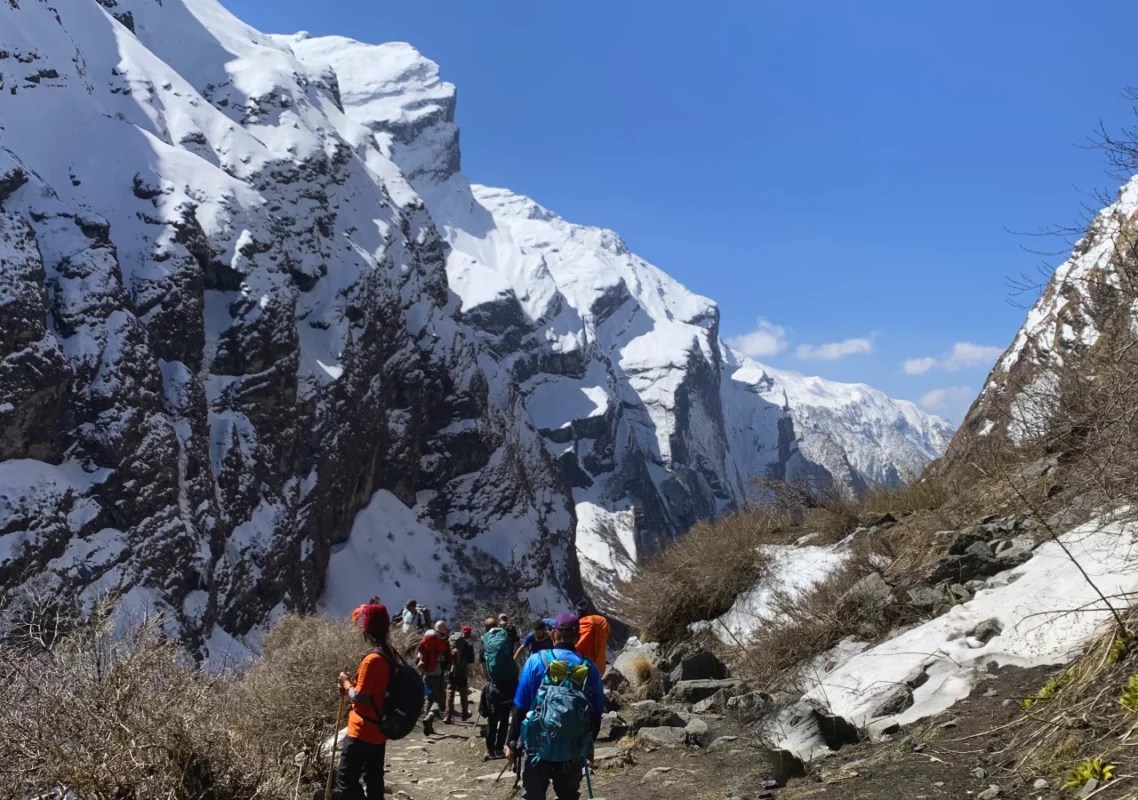
Leaving Chomrong Village you take a steep stone staircase that passes through the picturesque, terraced fields before crossing a suspension bridge over Chomrong Khola. After that, you take an uphill to the village of Sinuwa passing by Tilche. The trails are covered in dense forests of Rhododendrons, Bamboo, and Oak. You can find orchids, ferns, and mosses on the trail.
Following the trail led by the Modi Khola, you come across Kuldighar and Bamboo. On the forested trail, you can get glimpses of stunning Mount Annapurna III and Machhapuchhre (Fishtail). Another hour slightly ascend from Bamboo is Dovan, where we stay overnight today.
Activity: Trekking
Meal: Breakfast, Lunch, Dinner
Accommodation: Guesthouse
08
Day 08: Trek from Dovan to Deurali (3200M/10500Ft), Distance: 9 Km, Duration: 5 Hours
Trekking on this day is short and has gradual ascents. The dense forest of Oak and Rhododendrons starts to get thin and slowly approaches alpine landscapes. Leaving Dovan, there are stunning waterfalls along the way named as ‘Bahubali Jharana’ that you can enjoy.
Then, you come across a small rest stop at the Himalaya where you can take a short break before continuing to the next stop, Hinko (Hinku Cave). It is a historical small cave that was used as a camp for mountaineers during the early trekking and expeditions. Take a short glance and enjoy the scenic green valley with its beautiful gorge, cliffs, and soothing sounds of nature.
Following the distant views of Modi Khola, the journey takes on to the trails with barren hills, rocks, and small streams. With Nearing Deurali, you get to enjoy close-up views of Annapurna South, Hiunchuli, and Machhapuchhre (Fishtail). While you enjoy the thrill of crossing rivers and the scenic beauty alongside the windy trails, you reach Deurali without your consent.
Activity: Trekking
Meal: Breakfast, Lunch, Dinner
Accommodation: Guesthouse
09
Day 09: Trek from Deurali to Machhapuchhre Base Camp (3700M/12135Ft) Annapurna Base Camp (4130M/13545Ft), Distance: 8 Km, Duration: 5 Hours
With a beautiful morning at Deurali, you move on to your ultimate destination of the trip, Annapurna Base Camp (ABC). The journey continues on the thinning forested stone trails with the Rocky Mountains and the Modi Khola by the side. The Landscapes start to widen with the wildflowers, small waterfalls, and rocks around the area.
Then you reach Machhapuchhre Base Camp (MBC) from where you can see stunning snow-capped mountains like Macchapuchre (Fishtail), Hiunchuli, Annapurna South, Annapurna I/III, Bahrashikhar Chuli, Tharpu Chuli (Tent Peak), Ganggapurna, Gandharwachuli, and Tare Kang (Glacier Dome).
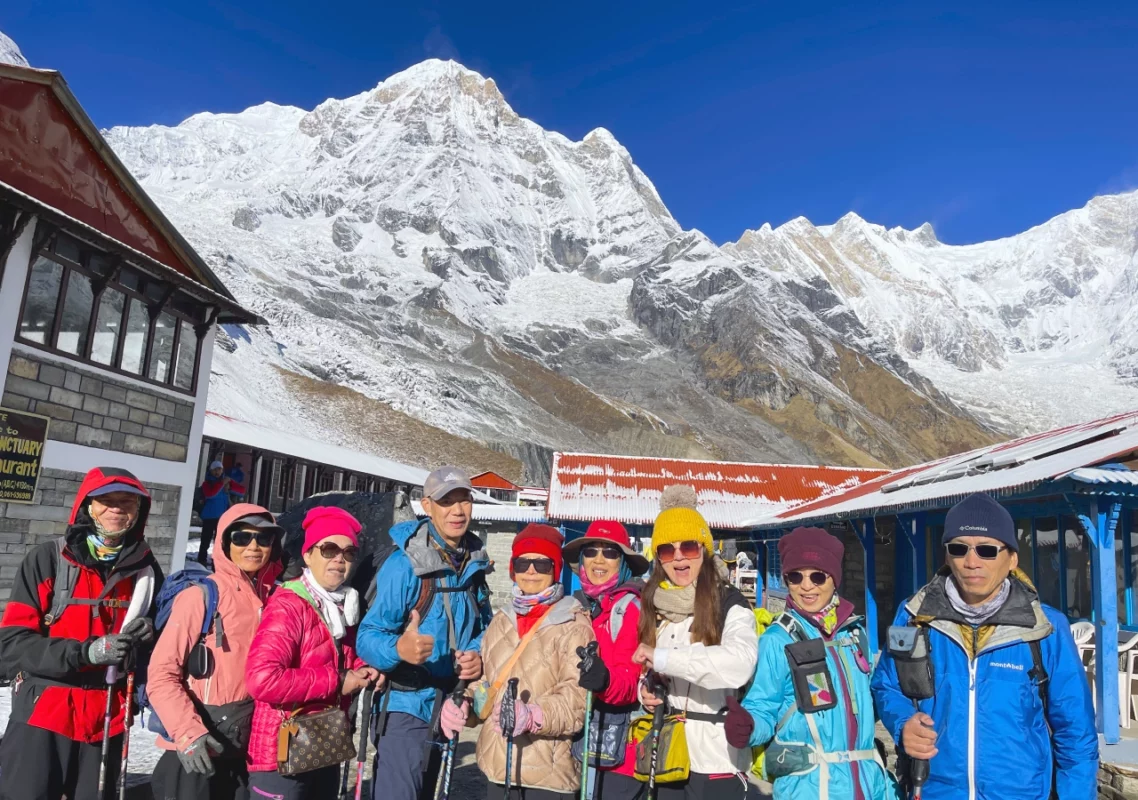
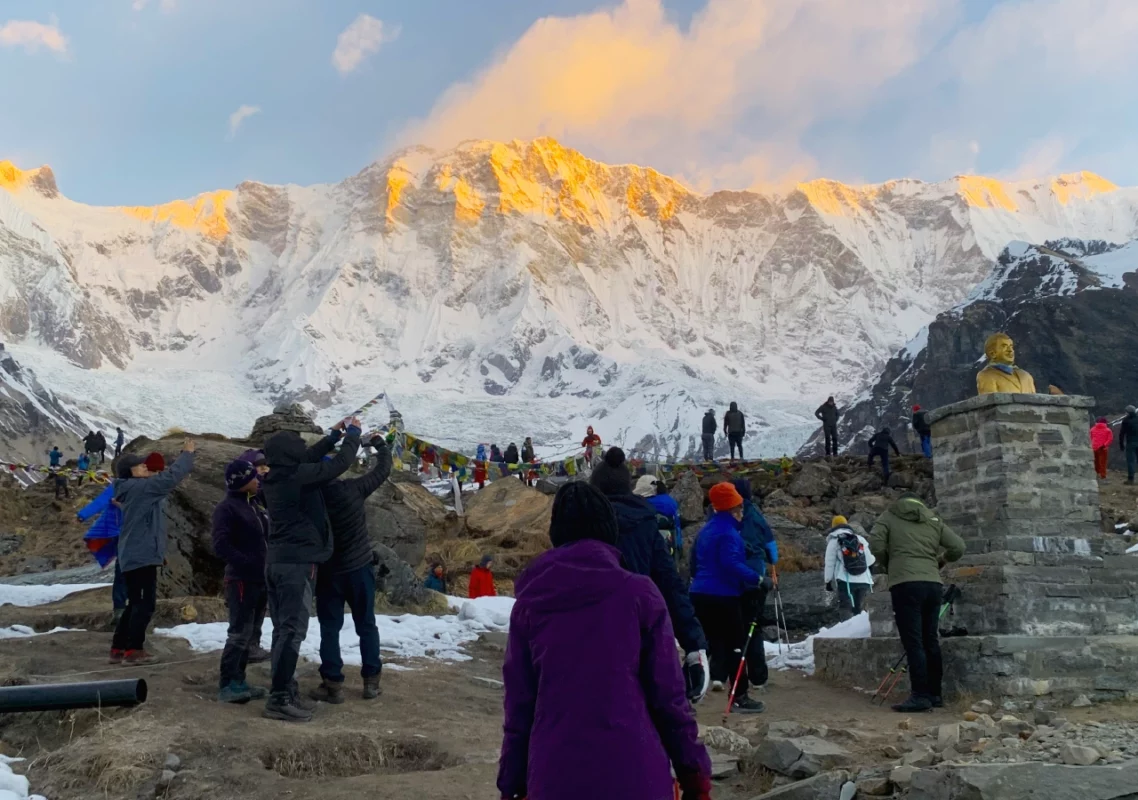
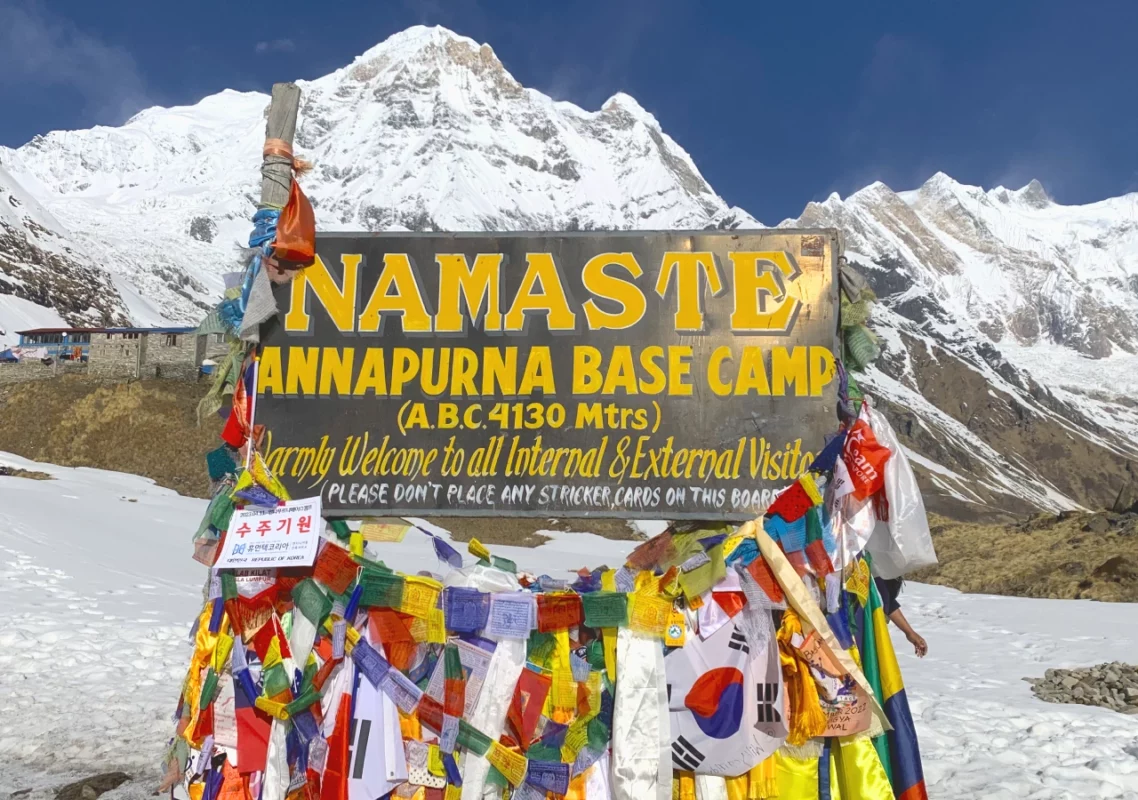
The trails are well-marked, guiding its way to the Annapurna Base Camp. Slowly, the way approaches the glacier valley. You can witness the stunning glaciers of Annapurna South. From the Annapurna Base Camp, you can witness the large landscapes backed up by the breathtaking mountain views of Annapurna South, Annapurna I, Hiunchuli, Gangapurna, Machhapuchhre, Bahrashikhar Fang, Tilicho Peak, Pisang Peak, and Dhaulagiri. Reflect on your trekking days and celebrate the moment of reaching the Base of the 10th-highest mountain in the world, Mount Annapurna I (8,091m).
Activity: Trekking
Meal: Breakfast, Lunch, Dinner
Accommodation: Guesthouse
10
Day 10: Trek from Annapurna Base Camp to Bamboo (2310M/7575Ft), Distance: 17-18 Km, Duration: 7 Hours
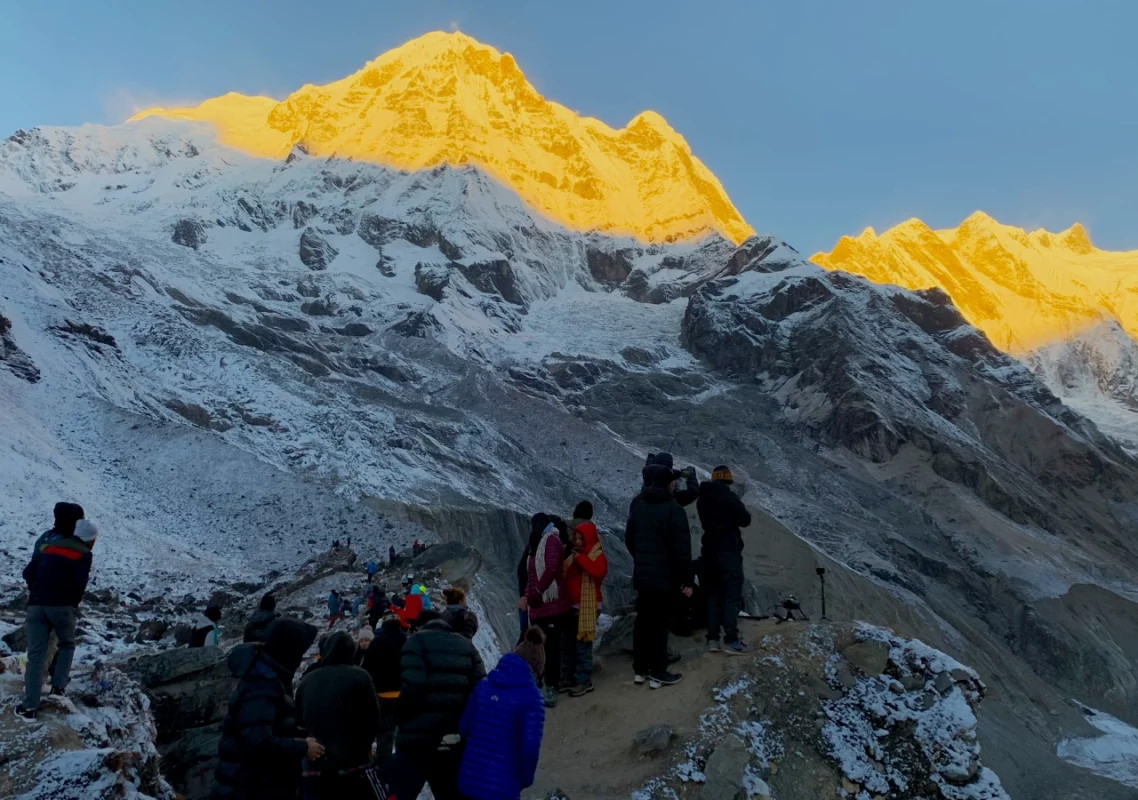
Rise early and witness the timeless sunrise above the great Himalayas of Annapurna! As the golden rays touch the snow peaks the sensation of warmth touches your skin. It looks like the peaks are breathing as the snow-top of the mountains starts to evaporate.
Take final glances at the golden peaks, waving goodbye to the mountains and glacial valley. With gradual descent and Passing by the Machhapuchhre Base Camp, the vast fields of wildflowers and grasses slowly shift into narrow forested trails. The journey is scented by junipers, vibrant rhododendron trees, and giant Oak trees. You pass by growling waterfalls and follow Modi Kola Riversides retracing your footsteps to the charming stops of Deurali, Hinko Cave, Himalaya, Dovan, and stay at Bamboo. Enjoy the dancing Bamboo ridges surrounding the area along with the relaxing wave sounds of the Modi Khola.
Activity: Trekking
Meal: Breakfast, Lunch, Dinner
Accommodation: Guesthouse
11
Day 11: Trek from Bamboo to Jhinu Danda (1780M/5840Ft)), Distance: 10-11 Km, Duration: 6 Hours and Drive to Pokhara, Duration: 2 Hours
From Bamboo, you continue on the forested trails, enjoying the green landscapes and distant mountain views. It begins with a steep downhill to a suspension bridge before going uphill. After crossing the bridge the stone steps guide your way to Chhomrong. From this point, the trails get steep downhill until Jhinu Danda.
Jhinu Danda is a popular for natural Hot Spring. If you are interested, break the day and you can soak into the warm Hot spring and spend some lovely time with natural warm bath and release the muscle tension. After Jhinu (Hot spring), you will hike further to jeep station. It is the last trekking moment of your Annapurna Base Camp journey. You will cross a suspension bridge. It is the longest and highest suspension bridge in the area. After crossing the Jhinu Bridge, you take a jeep to Pokhara. Enjoy evening in beautiful city Pokhara.
Activity: Trekking/Drive
Meal: Breakfast, Lunch
Accommodation: Hotel
12
Day 12: Drive from Pokhara to Kathmandu, Distance: 200 Km, Duration: 6 Hours
Today you return to the peaceful lakeside of Pokhara and back to Kathmandu City. It takes around 6 hours, depending on the road and traffic conditions. Enjoy the last glances of the hills, terraced fields, hills, flowing Marshyangdi and Trishuli Rivers, and charming villages. Reflect on your wonderful journey, take a rest, and chat with your members!
Activity: Drive
Meal: Breakfast
Accommodation: Hotel
13
Day 13: Departure/Farewell Day
Your wonderful Annapurna Base Camp journey has come to an end. Your guide or representative from the Explore Vision picks you up at the hotel and takes you to the airport 3 hours before the scheduled flight. Take a short farewell moment and see you next time!
Activity: Drive
Meal: Breakfast

Note:
If you have a private group and prefer a personalized experience, we can organize a custom trip tailored to your requirements and group size, running it any day you choose.
Price Includes

Price Excludes

What's included?
- All ground airport transfers are done in a private vehicle
- Two nights’ accommodation with breakfast at the best 3-star category hotel in Kathmandu
- Two nights’ accommodation with breakfast at the best 3-star category hotel in Pokhara
- Full board meals (breakfast, lunch and dinner) with tea/coffee during the trek
- Kathmandu to Pokhara and Pokhara to Kathmandu drive by deluxe tourist bus
- Pokhara to Birethanti and Jhinu to Pokhara by private vehicle
- Seasonal fruits – after dinner during the trek
- Best available twin sharing lodge to lodge accommodation during the trek
- One highly experienced, helpful, and friendly guide and a porter including their food, accommodation, salary, equipment and accidental insurance & and an assistant guide for more than five people group size.
- Duffle bag, down jacket and sleeping bag during the trek
- Company t-shirt, trekking map and trip achievement certificate
- A comprehensive first-aid medical kit
- ACAP (Annapurna Conservation Area Project permit) and TIMS (Trekkers’ Information Management System) card fees (please bring three passport photographs for the permit.
- All government taxes and entry fees
What's not included?
- International airfare to and from Nepal
- Nepal visa fee (it is payable upon arrival at Tribhuvan International Airport, (USD in cash is recommended)
- Travel insurance (it must include high altitude trekking above 4,000m, emergency evacuation)
- Accommodation, meals, and extra nights in Kathmandu outside the itinerary
- Personal expenses during the trek, like snacks, beverages, hot showers, charging electronics, and internet
- Tips for guide, porter, and driver (Expected but not mandatory)
Departure Dates
Start Date
07 Apr 2026End Date
20 Apr 2026Price
US$ 1030
 Guaranteed
Start Date
14 Apr 2026End Date
27 Apr 2026Price
US$ 1030
Guaranteed
Start Date
15 Apr 2026End Date
28 Apr 2026Price
US$ 1030
Guaranteed
Start Date
16 Apr 2026End Date
29 Apr 2026Price
US$ 1030
Guaranteed
Start Date
17 Apr 2026End Date
30 Apr 2026Price
US$ 1030
Guaranteed
Start Date
18 Apr 2026End Date
01 May 2026Price
US$ 1030
Guaranteed
Start Date
19 Apr 2026End Date
02 May 2026Price
US$ 1030
Guaranteed
Start Date
20 Apr 2026End Date
03 May 2026Price
US$ 1030
Guaranteed
Start Date
21 Apr 2026End Date
04 May 2026Price
US$ 1030
Guaranteed
Start Date
22 Apr 2026End Date
05 May 2026Price
US$ 1030
Guaranteed
Start Date
23 Apr 2026End Date
06 May 2026Price
US$ 1030
Guaranteed
Start Date
24 Apr 2026End Date
07 May 2026Price
US$ 1030
Guaranteed
Start Date
25 Apr 2026End Date
08 May 2026Price
US$ 1030
Guaranteed
Start Date
26 Apr 2026End Date
09 May 2026Price
US$ 1030
Guaranteed
Start Date
27 Apr 2026End Date
10 May 2026Price
US$ 1030
Guaranteed
Start Date
01 May 2026End Date
14 May 2026Price
US$ 1030
Guaranteed
Start Date
07 May 2026End Date
20 May 2026Price
US$ 1030
Guaranteed
Start Date
07 May 2026End Date
20 May 2026Price
US$ 1030
Guaranteed
Start Date
08 May 2026End Date
21 May 2026Price
US$ 1030
Guaranteed
Start Date
09 May 2026End Date
22 May 2026Price
US$ 1030
Guaranteed
Start Date
10 May 2026End Date
23 May 2026Price
US$ 1030
Guaranteed
Start Date
11 May 2026End Date
24 May 2026Price
US$ 1030
Guaranteed
Start Date
12 May 2026End Date
25 May 2026Price
US$ 1030
Guaranteed
Start Date
13 May 2026End Date
26 May 2026Price
US$ 1030
Guaranteed
Start Date
14 May 2026End Date
27 May 2026Price
US$ 1030
Guaranteed
Trip Information
Why Choose Explore Vision Nepal for Your ABC Trek?
We are a legally registered trekking company with more than 15 years of experience in helping people trek and tour around various destinations in Nepal. Our team is led by a founder who is an expert in travel and tourism. He has worked as a guide, porter, and expedition leader. Therefore, his experience helps us determine the best practices for a safe and enjoyable trek in the Annapurna region.
Similarly, all of our staff have obtained the necessary training and certification to assist in trekking to the mountain region. Our guides are well-insured and are aware of the safety protocols to be followed while on the trail. Furthermore, their training equips them to immediately attend to trailside illnesses, including minor injuries and Acute Mountain Sickness.
We try our best to meet all your needs and expectations and offer easy customization of the ABC trek. You can add extra days and increase your stay at certain landmarks. Likewise, include visiting the nearby sites that are not added to the normal itinerary. Our team’s hard work is well reflected by 5-star reviews from our customers on online platforms like Google and TripAdvisor.
At Explore Vision Nepal, we believe that prevention is better than a cure. Therefore, an oximeter continuously monitors the trekker’s oxygen level. Our standard treks incorporated enough acclimatization days before moving towards the upper areas. Guides can recognize early signs of discomfort on the trail by monitoring your activities. They are fluent in English, which enhances your trekking experience by breaking the language barrier between you and the locals.
Annapurna Base Camp Trek Cost
A standard ABC trek package costs from $700 to $1,500 for an individual. However, it varies depending on the itinerary and the number of trekkers in the group. A smaller number of travelers in the group increases the per-head expenditure. Likewise, itinerary customization can add to the standard prices.
An organized package offered by Explore Vision Nepal covers all the primary expenditure aspects. It includes accommodation services throughout the trek. Likewise, it covers three meals per day (breakfast, lunch, and dinner). Moreover, we obtain all the permits required for the trek.
The package provides a licensed guide with years of experience. Additionally, a porter will be provided to carry your extra luggage. All the transportation used during the trek is also covered.
Physical Fitness and Preparation Guide for The ABC Trek
Even though the trek does not require technical skills, you must have good health and stamina. It is better to start preparing at least 4 to 6 weeks before the trek begins.
We recommend you go on short hikes with uphill and downhill trails. This helps you prepare for the stone stairs and uneven paths during the actual trekking journey. Practice exercises that build legs and core strength, which result in better balance and reduce the probability of physical strain. Activities like jogging and stair climbing are excellent ways to improve your stamina.
At higher altitudes, the oxygen level is low, and the atmosphere is thinner than that of lower areas. Therefore, practice breathing exercises to improve oxygen intake and promote controlled breathing.
While trekking, it is important to continue preparing yourself for the coming days. So, have a fresh and nutritious diet that gives you energy and stay hydrated. It plays an important role in keeping symptoms of AMS under control.
Here are some important tips to help you create a perfect experience through comfort:
- Do simple exercises like walking, short hikes, stretches, cardio and breathing practice
- Have a basic knowledge about Trekking region and Altitude sickness
- Choose reliable local travel company and insurance for any emergency
- Pack light and only carry essential stuff for trekking
- Worry less while hiking, keep your own pace and avoid walking fast and rush
Off-Season Trekking To Annapurna Base Camp
Even though the peak trekking seasons, spring and autumn, bring out the best of the trail, views, and trekking weather, they may not be for trekkers who like peace and calm. The Annapurna route is hustling and bustling with both domestic and international tourists. Furthermore, teahouses are often fully occupied. So, if you are someone who prefers fewer crowds, an off-season trek is ideal. So, Monsoon and Winter are the best times for relaxing and personal ABC trips. Despite harsh and fast-changing weather conditions, proper training, preparation, and professional help make the off-season treks blissful.
Monsoon Season for the Trek
Monsoon (June-August) rain clears the dust from the environment and flaunts the most luscious landscapes. When it is not raining, the scenic views of mountains and valleys are sharp and clear. The unique cloud pattern during this time provides an excellent window for artistic photography.
Likewise, the rivers and waterfalls are in full flow, adding a spectacular charm. However, be careful of the slippery trails after heavy rainfall. Wear water-resistant trekking gear and boots with a firm grip. And take the help of trekking poles or sticks for efficient trail navigation. Check the weather forecast before starting the trek and be aware of the possibilities of landslides and rockfalls along the way.
Winter Season for the Trek
Much like monsoon season, winter (December-February) brings a tranquil environment in the ABC trek. Snow covers the entire route and the surrounding peaks, which transforms the views into a winter wonderland. Lower regions remain easily accessible, but higher regions can have some temporary blockage from snow accumulation. Daytime temperatures are often pleasant for trekking. However, it is necessary to stay safe from the cold, so wear warm clothes. Likewise, go with a licensed local guide for better navigation on the snow-covered trails.
Safety Concerns on the Trail
While the ABC trek is considerably safe and does not pose any major danger, you should be mindful of a few factors that raise concern. Altitude sickness is the primary risk of the trek. The maximum elevation on the trail reaches 4,130 meters. While not as risky as other high-altitude mountain treks, trekkers can experience mild symptoms like nausea, muscle fatigue, dizziness, and headache. To avoid this, walk at a slow and uniform pace and, while ascending above 3,000 meters, take sufficient acclimatization time.
Another major factor of safety concern comes from weather conditions. No matter the season, the weather change is very swift around the mountains. Likewise, heavy rainfall in the monsoon season and sudden snowfall in the winter season affect the trail and visibility. So, wear proper trekking gear, keep your itinerary flexible, and have professional guidance.
The most challenging aspect of the Annapurna trek is the physically demanding trails. Prepare physically, particularly by enhancing your knee strength, for the trek to be more attainable. Likewise, wear well-fitted trekking boots and maintain careful footing to avoid tripping and falling.
If you are trekking to Annapurna during the monsoon/rainy season, the primary safety concern comes from natural hazards like landslides and rock fall around the gorge stretches. Follow the weather news. Likewise, listen to the local people; their observations over the years make them good judges of natural catastrophes. Wearing a lightweight helmet protects your head from direct and sharp rock hits.
The best way to ensure overall safety on the trail is to hire a licensed local guide who will be with you every step of the way. And to stay covered if anything unexpected happens, get a comprehensive travel insurance.
Annapurna Base Camp Trek Permit
You will require the Annapurna Conservation Area Project (ACAP) Permit for the Annapurna Base Camp Trek. ACAP costs 3,000 Nepali rupees per person per entry. The primary reason behind this permit is to protect the conservation area and its flora and fauna. Moreover, it regulates trekking activities and contributes to community-based tourism. The amount collected from the ACAP is reinvested in environmental protection and rescue coordination.
Nature and Environment of Annapurna Trek
The Annapurna region is known for its ecological diversity. Starting from the lower subtropical valleys and ending in the glacial basin of Mount Annapurna, you get to explore endless flora and fauna.
Moreover, it takes trekkers through the Annapurna Conservation Area. This protected region is inhabited by various wild species. The most dominant mammals in the lower forests are Langur monkeys, Himalayan tahr, and barking deer. Red pandas are usually spotted in jungles near Deurali. Likewise, upper regions are home to the elusive snow leopards.
Furthermore, it is a dream of birdwatchers around the world, with more than 450 species of birds. Amongst them, trekkers mostly spot Danphe and bearded vultures.
Different Ecological Zones of the Region
There are four distinct environmental regions that you walk through during the trek.
- Subtropical zone
- Temperate forest
- Sub-alpine and alpine zones
- Glacial zone
The subtropical layer flaunts a lush and humid environment with Rice fields, Sal forests and Temperate jungles. Similarly, rhododendron and oak forests are common in the temperate regions. These forests are radiant with different shades of wildflowers. And are enveloped by moss and orchids.
As the trek transitions to subalpine regions, pine and juniper forests come into sight. Above 3,500 meters, trees get sparse, and the terrain changes to grasses and wildflowers. Lastly, the glacial region of the Annapurna region comprises ice, rocks, and moraines. Vegetation is mostly out of sight as glaciers and snow-covered peaks start showing.
Unique Ueography
The Annapurna sanctuary forms almost a perfect circle of mountains and 10 of them are higher than 6,000 meters. The most prominent ones are Annapurna I (8,091 meters), Annapurna South (7,219 meters), Machhapuchhre (6,993 meters), Gangapurna (7,455 meters), and Annapurna III (7,555 meters). Similarly, Modi Khola originates from the Annapurna South Glacier. The stunning milky turquoise shade of the river becomes even more breathtaking when sunlight hits its surface.
Medicinal Plants in the Region
The Annapurna Conservation Area is home to various medicinal herbs and trees that Gurung and Magar locals rely on for curing various sicknesses. The upper region produces dhupi, jatamasi, and yarsagumba. Burning dhupi is believed to purify the atmosphere and its oil is used for skin infections and respiratory health problems. Yarsagumba is a natural immunity booster, as it improves stamina and overall health. Oil obtained from the root of the jatamansi plant is used as a treatment for insomnia and anxiety.
The middle range of the Annapurna region grows Dhasingre and Chiraito. Dhasingre’s oil contains a natural chemical that is used to cure diseases like arthritis. Furthermore, massaging it is believed to help with back pain and sore muscles. Chiraito is a widely used medicinal plant by the locals to help with fevers and malaria. The subtropical valleys are rich in Himalayan nettle; the juice obtained from its root is used for jaundice and stomach problems. And titepati leaves work as a natural insect repellent.
What To Pack For The ABC Trek?
Clothing items
- Thermal base layer
- Waterproof jackets and trekking pants
- A hat to protect from the sun
- Gloves and trekking socks
- Gaiters (for cold temperatures)
Footwear
- Trekking boots with a good grip
- Bring a pair of sandals to wear while you are at the teahouse.
- Take blister tape or moleskin for blisters.
Supplies to make trekking more convenient
- A backpack with a rain cover and several pockets
- Trekking poles or sticks are especially helpful on trails that are icy or slippery.
- Bring a headlamp or torch for early morning hikes and sunscreen with SPF for protection.
- A bottle and a tablet for purifying water.
- Tools for finding your way
- Snacks that are quick and give you a lot of energy
Personal goodies
- Basic first aid box
- Drugs for altitude sickness (talk to your doctor first)
- Sanitizers for hands
- Bathroom items
- Documents for your passport, visa, permits, and travel insurance
- Cash in Nepali rupees
- Chargers, adapters, and power banks
Responsible Trekking on the ABC Trail
Choosing to trek is not just about mountains, adventure, and achievement. It is deeply connected to the embrace of nature and the people living in the land of the Himalayas. Responsible trekking leaves a positive footprint while you have the experience of a lifetime. Here are some ways you can trek and pay respect to Mother Nature:
- Bring your water bottle refill and use it throughout the trek.
- Use marked traditional trails rather than shortcuts.
- Carry a small trash bag for collecting your waste, like tissue, food wrappers, and other plastics.
- Do not throw waste near the local streams or taps.
FAQs for Annapurna Base Camp Trek – 13 Days
 General
It is in central Nepal, inside the Annapurna Conservation Area. This area is known for its diverse landscape and mountain culture and traditions.
The maximum altitude of the trek is the base camp itself, as it stands at 4,130 meters above sea level.
The Annapurna Base Camp trek is moderately challenging. The majority of the trek’s difficulty comes from the rapidly changing terrain with constant ascents and descents. There are chances of altitude sickness. However, it is less in contrast to other mountain treks like Everest and Kanchenjunga.
Yes, ABC is a beginner-friendly trek with no major altitude gain. However, you do need to have good physical health and good stamina. Most of the new trekkers complete this journey with proper mental and physical preparation and the help of a licensed guide.
As long as they are in good health and free of respiratory or major heart issues, the trek is doable for both the elderly and children. While there is no official age limit, it is better if children are above 10 years old, as they are more physically active and can sustain walking for long hours.
The Nepal government prohibited solo treks in the major areas around the Everest and Annapurna regions. However, with varying enforcement of the rule, you can go on a solo Annapurna Base Camp trek. But it is recommended to go via a registered tour operator like Explore Vision Nepal for stress stress-free experience. We do all the paperwork, take care of lodging, and maintain high safety standards.
The ABC trek is typically 7 to 12 days long. However, the itinerary can be modified to meet your schedule, and the trek can be as short as 5 days. Likewise, it can also be extended with more leisurely days at various landmarks.
Per day walking hours in the Annapurna Base Camp trek are approximately 5 to 7 hours. However, trekking hours can fluctuate based on your pace and the destination of the day.
Yes. Your hotels in Kathmandu provide a separate locking space to keep your luggage until you get back from the trek or you can store your extra items at the hotel in Pokhara. Moreover, we would have no problem storing them at our office either. There is absolutely no need to carry everything with you throughout the trail.
 Insurance & Visa
Yes. Trekkers should get insured by an authorized insurer for the trek. The insurance policy needs to cover the emergency helicopter rescue and hospitalization. Check the altitude range for helicopter evacuation explicitly, as it is generally capped at 3,000 meters to 4,000 meters.
 Guides & Support Staff
Yes, you should have a licensed trekking guide with you to do a trek in Annapurna, according to the Nepal government rules, you are not allowed to do solo trek in the region. And it is also secure, enjoyable, informative and worriless travel with a local guide.
Yes, most of the local licensed trekking guide speaks good English, communicate and provide you the wonderful trekking experience. At Explore Vision Nepal, we operate the fully guided trip by the licensed, experienced and professional trekking guide.
On the Annapurna route, porters typically carry about 25 to 30 kg of luggage. You will carry your personal bag with valuables, like a passport, cash, and a visa, by yourself. At Explore Vision Nepal, we ensure our porters are not overburdened, keeping their loads at safe and reasonable weights.
While tipping is not a must-do thing, it is customary to show gratitude towards the support staffs for making your journey safe. Depending on the trek and service provided, a $5 to $10 tip per day is standard.
 Health & Safety
Health posts are available in the lower regions, like Ghandruk or Landruk that treat minor injuries and basic health issues. Medical services become limited as you reach the highland.
Your immediate care providers are our guides or the locals. In severe cases, emergency helicopter services with hospitalization in cities are the only solution. So, be cautious on the trail, do not gain altitude too quickly. Stay hydrated and eat freshly made, simple meals to avoid stomach problems.
Our team at the capital is constantly in touch with our staff on the trail. Even in areas with bad network coverage, they communicate with us via satellite phone. So, as soon as possible, we will coordinate with each other. Then reach out to your insurer and make sure the rescue operation starts in no time. In the meantime, the guide provides you with immediate first-aid care. In case of altitude sickness, we bring you down to lower elevations and let you rest well.
 Booking & Payment
Customers should provide 15% of the complete package cost to confirm the final booking of the trek. The company does not refund this amount in case of cancellation.
Yes. If you are unable to join the trek and do not want to waste the booked trip, then you can easily transfer it to your friend or family member. However, the other person has to be of the same nationality as the initial client who confirmed the booking.
 Connectivity & Transaction
The two most common options for internet while on the trek are mobile networks (Ncell or NTC) and Wi-Fi provided by the teahouses. Mobile data from local SIM cards provides reliable service in the lower region, but it becomes less dependable as you get closer to the base camp. Wi-Fi service quality also varies with the teahouses and altitude.
Yes. You can use common charging outlets at the teahouses. Some places take an additional fee per hour, so make sure to clear it with the owner. Likewise, the charging spaces are open, so you are in your own charge of your device’s safety.
After leaving the major cities, the remaining Annapurna trail is almost a cash-only area. You can make online and card payments only in areas around Ghandruk or Jhinu Danda. As you ascend from here and leave Chhomrong, most places take cash payment only. So, exchange dollars for Nepali rupees at the bank or reliable money exchange counters.
Trip Reviews


