
24x7 Support
+977 9851349597
Unbeatable Holiday Offers - Save Up to 20% on Your Next Adventure!



Circle the Annapurna Massif on foot, crossing the legendary Thorong La Pass!
Annapurna Circuit Trek – 14 Days
Based on 60 reviews
With an extraordinary blend of geographic diversity and deep mountain cultural roots, the Annapurna Circuit Trek is one of the most beautiful trekking destinations in the Annapurna Himalayan region of Nepal. On this journey, you circle the stunning mountain range over 14 days and pass through Nepal’s most dramatic environmental transitions. From Lush, subtropical riverside trails to plateau deserts to the high-altitude glacial paths.

Duration
14 Days
Trip Difficulty
Difficult
Max Altitude:
5,416m. / 17,769ft.
Activity
Hiking | Trekking
Group Size
1-20
Best Season
Autumn | Spring
Meals
Breakfast, Lunch & Dinner
Accommodation
Hotel | Guesthouse
Transportation
Private Vehicle | Flight | Tourist BusOverview of Annapurna Circuit Trek – 14 Days
Annapurna Circuit trek is a complete round trek around Mount Annapurna, following through changing terrain and culturally rich mountain communities. This classic 14-day trekking route starts in the lower valleys along the Marshyangdi River, through dense forests and terraced fields.
As you gain altitude, the trail passes through the dry terrain of the Manang district, the glacial path of Thorong, and descends to the pilgrimage sites of the Mustang region. Our 14-Day Annapurna Circuit covers lower Valley traditional villages, Manang acclimatization, Thorong La Pass crossing, and a descent through Muktinath and Jomsom.
What Makes the Annapurna Circuit Trek Special
A complete circuit around Annapurna: Starting from Jagat and ending at Jomsom, you do a complete round of the 10th highest mountain, Annapurna. You get to travel through two completely distinct Nepal Himalayan regions, Manang and Mustang. Also, while you are completing this circuit, you get to see many mountains along with the 8th highest mountain in the world, Mt Manaslu.
Unique landscapes: On the journey of Annapurna Circuit, there are constant changes in terrain, including the trans-Himalayan section. On the way, you can find sub-tropical river valleys, rocky cliffs, lakes, glaciers, alpine deserts, and high-Himalayan plateau.
Cultural diversity on the trail: The trail passes through the traditional villages of Gurung and Magar closely. In the Manang region, the journey is enriched by rich Buddhist culture, such as the ancient monastery of the Braga village, chortens by the sidewalks, and mani walls.
After you cross the high pass and travel through the Mustang region to Muktinath, there are pilgrimage sites for both Hindus and Buddhists with 108 holy water sprouts and an eternal flame.
Cross the highest trekking pass of Nepal: Thorong La Pass, located at 5,416 meters high from the sea level, is one of the major reason the Annapurna Circuit Trek is special. It is the most challenging and beautiful point of the trek that challenges your endurance level both mentally and physically, then rewards you with the panoramic views across the Annapurna and Dhaulagiri mountain ranges.
Journey around Kali Gandaki (deepest gorge on earth): After crossing the high point of the journey, the trail descends along the Kali Gandaki river valley toward Kagbeni, Jomsom, and Tatopani, allowing trekkers to view the dramatic terrain cut by the Kali Gandaki between Annapurna and Dhaulagiri.
One of the best summer treks in Nepal: Due to the Rain-shadow effect in the Mustang/Manang region, it receives less rainfall, making it completely doable during the summer treks when most of the other treks face heavy rainfall.
Difficulty of the Annapurna Circuit Trek: Who is it for
The Annapurna Circuit Trek is graded as moderate to challenging as it includes long walking hours, high-altitude trekking, mountain pass crossing, and long ascents/descents. It is suitable for trekkers with a good level of physical fitness and stamina. Some of the difficulties trekkers come across during this journey are:
Daily walking hours: Most days involve 5-7 hours of walking. Some longer days include Pisang to Manang (through the high route) and Thorong Phedi to Muktinath via Thorong La Pass (5,416m)
Altitude gain: The trek climbs steadily from around 760m in the lowlands to 5,416m at Thorong La Pass, the highest point of the journey.
Terrain variety: Trekkers cross suspension bridges, walk along riverbanks, climb stone staircases through forest, and walk rocky high-altitude trail sections near the pass.
Changing weather: Mornings at high altitude, especially around Yak Kharka, Thorong Phedi and the pass itself, can be extremely cold, and conditions can change quickly.
Trekkers who have completed treks like Poon Hill, Annapurna Base Camp trek or similar short treks in around 3,000 to 4,000 meters elevation, will find the early stages of the Annapurna Circuit familiar, though this trek goes considerably higher and lasts longer. Our guides continuously monitor pace and symptoms of altitude sickness. Also, the itinerary has an acclimatization day in Manang to reduce risk before the push toward Thorong La.
Why Book your ACT Trip with Explore Vision Nepal
Local company with local expertise: We are based in Nepal, and our itineraries, pacing, and route knowledge come from years of firsthand experience on the Annapurna Circuit trail.
Experienced, licensed guides: Every trek is led by government-licensed guides trained in first aid, altitude sickness prevention, and wilderness safety, many of whom have grown up in or near the regions we trek through.
A young, dedicated, customer-service-oriented team: From your very first enquiry to your farewell at the airport, our team is responsive, attentive, and genuinely invested in making sure your trip runs smoothly and that any concerns about the journey are addressed quickly.
Flexible booking and customizable itineraries: we understand that not every trekker fits into the same itinerary. Whether you need extra acclimatization days, want to add the Tilicho Lake extension, or need to adjust the schedule around flights, we work with you to tailor the Annapurna Circuit Trek itinerary to your needs.
Attentive customer care, before and after the trek: We stay in contact throughout your booking process, provide detailed pre-departure information, and remain available for support throughout your time in Nepal.
Complimentary gear and services included: To help you pack and keep you warm on this trekking journey, we provide complimentary gear for the trek
- Down jacket for high-altitude sections
- Warm sleeping bag
- Explore Vision Nepal branded t-shirt
- Duffel bag for porters to carry your gear
- Trekking route map
- Certificate of trip completion


Outline Itinerary of Annapurna Circuit Trek – 14 Days
Day 01: Arrive at Tribhuvan International Airport (TIA), Kathmandu (1,350M/4,430Ft)
Day 02: Drive from Kathmandu to Besishahar to Jagat (1300M/4265Ft), Distance: 210 Km, Duration: 7-8 Hours
Day 03: Trek from Jagat to Dharapani (1,860M/6,100Ft), Distance: 12 Km, Duration: 6 Hours
Day 04: Trek from Dharapani to Chame (2,630M/8,625Ft) Distance: 15 Km, Duration: 6-7 Hours
Day 05: Trek from Chame to Pisang (3,300M/10,825Ft), Distance: 14 Km, Duration: 6 Hours
Day 06: Trek from Upper Pisang To Manang (3,540M/11,610Ft) Distance: 18 Km, Duration: 7-8 Hours
Day 07: Acclimatization Day, Hike to Gangapurna Glacier Lake and Chongkar Viewpoint. Distance: 6 Km, Duration: 3 Hours
Day 08: Trek from Manang to Yak Kharka (4,050M/13,250Ft), Distance: 11 Km, Duration: 5-6 Hours
Day 09: Trek from Yak Kharka to Thorong Phedi (4,450M/14,595Ft), Distance: 7 Km, Duration: 5 Hours
Day 10: Trek from Thorong Phedi to Muktinath (3,800M/12,465Ft) Crossing Over Thorong La Pass (5,416M/17,765Ft), Distance: 16 Km, Duration: 8 Hours
Day 11: Trek from Muktinath to Jomsom (2,720M/8,925Ft), Distance: 15 Km, Duration: 6 Hours
Day 12: Fly from Jomsom to Pokhara (820M/2,690Ft), Duration: 30 Minutes
Day 13: Drive from Pokhara to Kathmandu (by Comfortable Tourist Bus), Distance: 200 Km, Duration: 6-7 Hours
Day 14: Departure | Farewell Day
Trip Highlights
- Walk from the sub-tropical forest zone to Trans-Himalayan desert landscapes in 14 days.
- Circle the entire Annapurna Mountain region. Be around the world’s 10th highest peak throughout your Circuit journey.
- Enjoy views of Annapurna II, Annapurna III, Annapurna IV, Dhaulagiri, Lamjung Himal, Manaslu, Tilicho Peak, Pisang Peak and many himalayan mountains on the journey.
- Witness one of the biggest apple farms in the region at Bhratang, along with its apple products and farmhouse resort, right on the circuit trail from Chame to Pisang.
- Pass through the stunning sights of Paungda Danda, locally known as ‘Swarga Dwar’ (Gateway to Heaven), a massive curved rock wall rising above the River above Bhratang.
- Explore Ghyaru and Ngawal, two peaceful villages in Manang with breathtaking scenery that every trekker talks about.
- Cross Thorong La Pass (5,416m), one of the highest and most thrilling trekking passes in the Nepal Himalayas.
- Witness various Himalayan wildlife, like, Himalayan Tahr, marmots, pikas, and Blue Sheep.
- Walk straight into the living culture of Gurung, Magar, Manangi, and Thakali people.
- Experience the spirituality of Muktinath Temple, one of the holiest sites in the Himalayas, valued by both Hindus and Buddhists.
Itinerary Overview of Annapurna Circuit Trek – 14 Days
It begins with a drive from Kathmandu to Jagat, followed by trekking through villages like Dharapani and Chame. This section includes forest and river trails, with suspension bridges. Then you climb to Upper Pisang and the arid landscapes of Ghyaru, Ngawal, and to Manang village.
For acclimatization on this trek, you stay an extra day in Manang while exploring a side trip to Gangapurna Lake and Chongkar viewpoint. Then it continues higher to Yak Kharka and Thorong Phedi before the challenging Thorong La Pass.
After the pass, you descend to Muktinath, continuing to Kagbeni and Jomsom. Then, as per our itinerary, you take a return flight connecting from Jomsom to Pokhara before finally ending the Annapurna Circuit Trek journey with a drive back to Kathmandu.
Annapurna Circuit Trek – 14 Days Itinerary
01
Day 01: Arrive at Tribhuvan International Airport (TIA), Kathmandu (1,350M/4,430Ft)
Welcome to the country of the Himalayas! As you land at the airport and get off, you can feel a sensation of thrill, excitement, and energy. Our representative waits for your arrival with a warm heart and an EVN’s postcard in hand. Then, you are transferred to your hotel.
Once you check in, unpack your luggage, freshen up, and take a rest!
Later, we will have a short trip meeting together. Introduce with your trekking guide, provides you with brief information about the trip. You are free to ask any questions and discuss the trip expectations. At the same time, we will hand over you, trekking duffel bag, down jacket, sleeping bag, trekking map etc.

Activity: Driving

Accommodation: Hotel
02
Day 02: Drive from Kathmandu to Besishahar to Jagat (1300M/4265Ft), Distance: 210 Km, Duration: 7-8 Hours
Your way to the Annapurna Circuit Trail starts with an early morning drive along the Prithvi Highway, following the Trishuli and Marshyangdi rivers to Besisahar. It is a large and major village that serves as a lunch stop before heading into the remote section of the Annapurna region. On the ride, you can see the agricultural fields of the locals and scenic views with hills and rivers on both sides.
After Besisahar, the road gets slightly off-road along the Marshyangdi River valley to reach Jagat. This village is around rocky hills and has buildings colored in vibrant shades of royal blue and green. The total drive from Kathmandu to Jagat is approximately 210 Km today.
Activity: Drive

Meal: Breakfast, Lunch, Dinner
Accommodation: Guesthouse
03
Day 03: Trek from Jagat to Dharapani (1,860M/6,100Ft), Distance: 12 Km, Duration: 6 Hours
The journey starts at the lower valley of the Annapurna Circuit, where you pass by the villages, suspension bridges over the river, and forest. The village sections in the lower areas are mostly packed and have more facilities than the upper villages.
Entering Manang district, from Jagat the trail climbs gradually through subtropical forests, passing small settlements like Chamje and Tal. Although it is just the beginning of the trek, you get a stunning experience with the river and side villages.
The trail opens up to the wide valley with occasional waterfalls. On the way, you come across several suspension bridges and small up and downhill toddy, adding to your experience, leading the way to Dharapani village.
Activity: Trekking
Meal: Breakfast, Lunch, Dinner
Accommodation: Guesthouse
04
Day 04: Trek from Dharapani to Chame (2,630M/8,625Ft) Distance: 15 Km, Duration: 6-7 Hours
The trail now ascends through the pine and Oak forests past Bagarchhap village and Timang village, with occasional mountain views of Manaslu and Lamjung Himal. You pass through the stone step sections in the shadows of the forest with small streams and waterfalls. The first half of the day you climb about 800 to 900 meters, making it the hard part of the day.
After Timang, it continues along the riverside to Koto village. Then the trail takes its final gradual push to Chame, the administrative headquarters of the Manang District. It has several teahouse options for the trekkers with Greenhill and snowcapped mountains view.
Activity: Trekking
Meal: Breakfast, Lunch, Dinner
Accommodation: Guesthouse
05
Day 05: Trek from Chame to Pisang (3,300M/10,825Ft), Distance: 14 Km, Duration: 6 Hours
The trail starts through a narrow valley with motorable road section in the beginning of the day. It climbs through the pine and Rhododendron forest, with some rocky paths. On the way, you pass through the curved path below the Paungda Danda rock face, standing dramatically above the river.
The valley then opens up to the stunning view of the Paungda Danda (Swarga Dwar) rock wall. Then the trail gets drier, climbing steadily upwards towards the Upper Pisang, via Dhikur Pokhari. This is a small and beautiful settlement with stunning mountain views of Annapurna I, Annapurna III, Annapurna IV, Gangapurna, and Pisang.
Activity: Trekking
Meal: Breakfast, Lunch, Dinner
Accommodation: Guesthouse
06
Day 06: Trek from Upper Pisang To Manang (3,540M/11,610Ft) Distance: 18 Km, Duration: 7-8 Hours
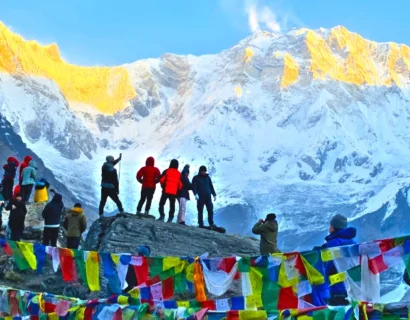
If you wake up early morning today, you have a chance to witness the sunrise on Annapurna Mountain range from Upper Pisang.
The upper route through Ghyaru–Ngawal to Manang is recommended today
After breakfast, moving forward from Upper Pisang, you come across the beginning of the Annapurna arid landscape as you head towards one of the most beautiful villages of the trek, Ghyaru, the uphill to reach Ghyaru village is the difficult part in the morning. The stunning view of Annapurna Mountain and the surrounding landscape from Ghyaru Stupa is something you should not miss on this Annapurna Circuit trek.
After Ghyaru, the trail moves towards another beautiful village of Ngawal. Ngawal is a historic tiny village with stone homes blending into the deserted hill. The scenery around here highlights the Annapurna and Gangapurna mountain ranges.
Following, the terrain is deserted. You can find cultural landmarks like prayer wheels, mani gates, and Gompas, showcasing the region’s dedication to Buddhism. It gets windier as you pass by the Ngawal and move towards old village of Braga. The trail goes mostly down and gradual flat following the motorable road mostly, midway before reaching Manang. It is the largest village in the area, a base for acclimatization before the Mountain Pass.
Activity: Trekking
Meal: Breakfast, Lunch, Dinner
Accommodation: Guesthouse
07
Day 07: Acclimatization Day, Hike to Gangapurna Glacier Lake and Chongkar Viewpoint. Distance: 6 Km, Duration: 3 Hours
This is the rest or acclimatization day of your Annapurna Circuit journey. On this day, you take a side trip to Gangapurna Tal (lake) and Chongkar viewpoint above the lake. From the viewpoints, you get majestic views of the Gangapurna, Annapurna III, Tilicho Peak, and the Manang Valley.
It begins at the central Manang, and crossing the bridge over the Marshyangdi River, you reach your first destination, Gangapurna Lake. Then the path climbs up to the rocky slope for about 1 hour to Chongkar viewpoint. From that point, you can get direct mountain views of Gangapurna, Tilicho Peak, Annapurna III, and surrounding landscapes.
After the completion of the hike, you descend back to the foot of Gangapurna Lake, where you can rest and enjoy the scenery before going back to Manang village.
The afternoon is yours – you can rest, explore the beautiful Manang village, or visit the Himalayan Rescue Association (HRA) post in Manang, as they hold informational classes or documentary screenings during peak trekking season.
Activity: Hiking | Exploring
Meal: Breakfast, Lunch, Dinner
Accommodation: Guesthouse
08
Day 08: Trek from Manang to Yak Kharka (4,050M/13,250Ft), Distance: 11 Km, Duration: 5-6 Hours
Leaving the Marshyangdi Valley, you dive into the gradual alpine ascent, where the temperature gets colder and vegetation starts to thin. On the way, it is easier to spot wildlife like blue sheep, Thars, and Yaks grazing.
The first ascent takes you to Tenki to Gunsang village (Ghunsang), these are small settlements with a mix of teahouses and stone houses. Ghunsang even serves as a common tea stop for trekkers, where you can enjoy the serene Annapurna Mountain View.
After moving up from the villages, it continues to Jarser Khola Valley, before arriving at the settlement of Yak Kharka. It is a high-altitude small settlement, situated between the steep mountains, offering a peaceful and restful spot.
Activity: Trekking
Meal: Breakfast, Lunch, Dinner
Accommodation: Guesthouse
09
Day 09: Trek from Yak Kharka to Thorong Phedi (4,450M/14,595Ft), Distance: 7 Km, Duration: 5 Hours
Today, the trek is shorter to conserve more energy above 4000m. With increasing elevation, you might feel reduced oxygen and increased physical demand while ascending. The trail takes you through snowy ridges and alpine terrain.
The path climbs gently through the barren valley, reaching Churi Ledar in about 30 minutes from Yak Kharka. The area is wide open, windy, with dramatic ridges.
As you hike upwards, you will enjoy the scenery as you are surrounded by beautiful Himalayan peaks and landscapes. You can witness some of Annapurna’s wildlife around here, as this is an area where snow leopards are sometimes spotted, and you will be able to see Himalayan vultures and blue sheep (mountain goats) quite often.
Moving forward, you cross a suspension bridge over the Jarsang River (one of the highlights of the day), which takes you to Thorong Phedi. The last section of the walk passes through a narrow, rock fall-prone area, so you need to keep your eyes open.
The base of Thorong La, Thorong Phedi is a small, basic shelter for trekkers doing the Annapurna Circuit trek, as it is not a native village. After Phedi, the only settlement before you push on to summit Thorong Pass is High Camp, which is 1 hour up from Thorong Phedi.
Activity: Trekking
Meal: Breakfast, Lunch, Dinner
Accommodation: Guesthouse
10
Day 10: Trek from Thorong Phedi to Muktinath (3,800M/12,465Ft) Crossing Over Thorong La Pass (5,416M/17,765Ft), Distance: 16 Km, Duration: 8 Hours
It is the most thrilling day of the Annapurna Circuit journey as you set off for the Thorong La High Pass. The crossing starts early morning to avoid high midday winds while climbing.
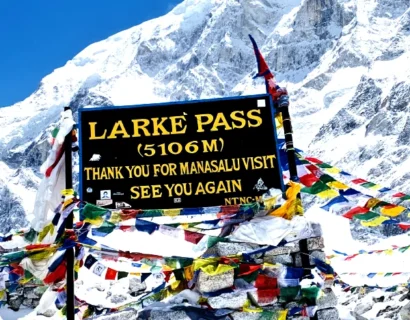
Starting at dawn, on the way you get to witness a stunning sunrise along the wide views of the mountains. Reaching the highest point, you can find that the point is decorated with prayer flags and a height recognition board. This point is situated between the peaks of Khatung Kang and Yakawa Kang. It also divides the Manang district from the remote Mustang district.
Enjoy each moment, celebrate it with your fellow trekkers, trekking crew and take some photos. You then take a long descent into the Mustang side of the Himalaya with a dry landscape. The trail coming down from the pass is mostly steep and rocky down to the Phedi on Muktinath side. The trail at the end is easier to the significant pilgrimage site of Muktinath.
Once you reach Muktinath village, you can freshen up and rest. Then, if you are interested in visiting the Muktinath Temple, you can do so in the late afternoon or evening, the temple is in 15 minutes’ walk from the town.
Activity: Trekking
Meal: Breakfast, Lunch, Dinner
Accommodation: Guesthouse | Attached-bathroom
11
Day 11: Trek from Muktinath to Jomsom (2,720M/8,925Ft), Distance: 15 Km, Duration: 6 Hours
The journey continues along the Kali Gandaki River Valley. It passes through Jharkot, a well-known village for its old fort-like architecture, and Kagbeni (the gateway to the Upper Mustang), for a 500-year-old monastery, Kag Chode Thupten Samphel Ling. These are the popular places for Tibetan culture and ancient monasteries of the region.
Then, following the windy Kali Gandaki riverside trail along a motorable road, while enjoying typical Mustang landscapes and views of the Nilgiri and Dhaulagiri mountains on a clear day, you reach the town of Jomsom, also known as the windy capital of Mustang. It is the administrative center of the Mustang district. This marks the end of the trekking segment of your Annapurna Circuit Trek.
Activity: Trekking
Meal: Breakfast, Lunch, Dinner
Accommodation: Guesthouse | Attached bathroom
12
Day 12: Fly from Jomsom to Pokhara (820M/2,690Ft), Duration: 30 Minutes
An early morning scenic flight from Jomsom Airport takes you down to Pokhara, the lakeside city.
As this mountain route can occasionally be affected by weather conditions or, at times, seasonal suspensions, Explore Vision Nepal keeps a flexible backup plan in place. Depending on your preference, we can wait for the next available flight or arrange a scenic drive to Pokhara via Beni, which our team is happy to organize on your behalf.
Once in Pokhara, the rest of the day is free for you to relax near the lakeside or explore the souvenir shops.
Activity: Flight
Meal: Breakfast
Accommodation: Hotel
13
Day 13: Drive from Pokhara to Kathmandu (by Comfortable Tourist Bus), Distance: 200 Km, Duration: 6-7 Hours
Today, you will take a drive from Pokhara to Kathmandu by tourist bus. The drive passes along the Prithvi Highway back to Kathmandu. It is a long but scenic drive, includes both smooth and bumpy roads, so you might want to rest or take a final look back at the beautiful hills, terrace fields, river, and villages along the roadside
Activity: Drive
Meal: Breakfast
Accommodation: Hotel
14
Day 14: Departure | Farewell Day
For the air transfer back home with the beautiful memory and experience of Annapurna circuit region, your guide or a representative from our team picks you up at the hotel. Then, drop you off 3 hours before the scheduled flight. Catch the final glimpses of Kathmandu alleys, stupas, temples, and prayer wheels on the drive.
At the airport, our representative provides a short farewell section with a see you next time!
Activity: Drive
Meal: Breakfast

Note:
If you have a private group and prefer a personalized experience, we can organize a custom trip tailored to your requirements and group size, running it any day you choose.
Trip Information
Where You Stay: Accommodation on Annapurna Circuit Trail
Along the trekking route, you stay at accommodation that consists of twin-sharing rooms in local teahouses. The room simply consists of two single beds, mattresses, pillows, and blankets. Most of them have wooden walls with minimal insulation, making them cold at higher altitudes.
For charging your electronic devices, there is electricity. But some teahouses might cost you extra for charging. Most teahouses also offer Wi-Fi these days, usually for an additional charge. For mobile networks, NTC and Ncell connections work reasonably well up to Manang village; beyond this point, signal gets weaker and is largely unavailable for around 2 to 3 days, through Yak Kharka, Thorong Phedi, and roughly halfway to Muktinath after the pass.
As you get closer to Muktinath, both networks start working reliably again. And for toilets, mostly there is a mix of western-style and squat-style toilets. And if you want to take a shower, hot showers (gas-heated or solar) are available with an additional charge.
Stop-by-stop Accommodation: According to the Annapurna Circuit itinerary
Jagat Village: Standard teahouse/guesthouse; as it is at a lower altitude, there is better insulation and menu variety with comfort.
Dharapani: Basic-standard teahouse as a start of classic circuit; it is simple but reliable.
Chame: There are standard lodges (some with attached baths) as a district headquarters of Manang; some have solar showers available.
Upper Pisang: Standard guesthouse with better mountain views. The facilities are basic and clean.
Manang: Best lodges and guesthouse on the Annapurna Circuit, with attached bathroom and hot showers available.
Yak Kharka: Basic high-altitude teahouses that are small, with limited electricity.
Thorong Phedi: Basic teahouses with simple rooms with beds. Mostly common sharing toilets. Proper shower is not available at thorong phedi. This is the last stop before the adventures Thorong Pass.
Muktinath: Standard guesthouse/hotel style with improved facilities available at Muktinath. Better rooms with attached bathroom and more reliable hot showers.
Jomsom: Hotel-style/standard guesthouse, with power outlets and better menus including Thakali Dal Bhat Set.
Best Time for the Annapurna Circuit Trek
The ideal period for trekking at the Annapurna Circuit is Autumn (September-November) and Spring (March-May), these seasons are considered as the best time to trek in Nepal Himalayas. Normally, we can expect the weather stability, manageable trails, and ideal conditions for crossing Thorong La Pass during this of of the year.
Autumn (September to November): These are the post-monsoon months, which are widely considered the best season. The temperatures range from 10 to 20 degrees in lower regions. Skies are typically clear, and visibility of the Mountains is at its best.
Spring (March to May): The spring is the another perfect season to explore in Nepal and doing the Himalayan trekking. Lower elevations in the Annapurna circuit, come alive with blooming rhododendron forests, especially, April is the best month to see Rhododendrons in Annapurna region.
During the spring season, daytime temperatures on the trail are milder, though mornings and evening near Thorong La remain cold. These months are best if you prefer the wilder beauty of flora and comparatively warmer temperature in the high Himalayas.
Summer/Monsoon (rain shadow advantage): As it is the rain shadow destination of Nepal, the region is most likely to have minimal to no rainfall during the period. That makes it accessible even in the summer monsoon days. The temperatures are moderate, and only in some lower areas might you face wet trails, rainfall, mud, and leeches in some places.
Winter (December to February): It is possible but considerably more demanding. Thorong La Pass can be closed by heavy snowfall, and temperatures at higher elevations drop well below -20 degrees. Only experienced, well-equipped trekkers with flexible itineraries should attempt this season, and route conditions should always be checked locally before departure.
Altitude Sickness and Acclimatization on ACT Trail
Altitude sickness is one of the safety considerations on this Annapurna Circuit Trek, which reaches up to 5,416m high-altitude at Thorong La Pass. This occurs when you ascend faster without letting your body adapt to the new oxygen levels. If your body cannot keep up with your pace at high altitude, symptoms like headache, fatigue, insomnia, and loss of appetite might occur, which points to altitude sickness.
According to our itinerary for this trek, there is a low to moderate risk in the lower region, like Jagat, Dharapani, Chame, and Pisang. Climbing higher, there is high risk at Manang, Yak Kharka, Thorong Phedi to Thorong La Pass as the altitude ranges from 3,300m to 5,416m at the highest point. After that, there is low risk as the altitude decreases with descent to Muktinath and Jomsom.
Note: Concerning the health and safety aspects of high-altitude trekking in Nepal, and to accommodate the elevation gain, our itinerary is designed specially with an acclimatization stop at Manang. It is one of the best places to stop and acclimate before the high Pass. Trekkers are encouraged to walk at their own pace, stay well hydrated, and report to your guide if you suffer any symptoms immediately.
Travel Insurance for Annapurna Circuit Trek
As this trek includes crossing Thorong Pass with extreme elevation, you must have travel insurance covering trekking up to 5,500m. Standard policies that have 3,000m to 4000m are insufficient for the trek. It should also cover immediate emergency helicopter evacuation. The evacuations are the primary emergency response for severe altitude sickness.
Note: To verify this process, we require a copy of your verified travel insurance policy. Please confirm this coverage before your trip begins, as it is a required safety measure.
Permits and Guide Required for the Annapurna Circuit Trek
Currently, The Annapurna Conservation Area Permit (ACAP) is the mandatory permit for the Annapurna Circuit Trek.
Annapurna Conservation Area Permit (ACAP): This permit is required for all trekkers who enter the Annapurna Conservation Area by the government of Nepal (National Trust for Nature Conservation). As this trek is done within the area, you need an ACAP. The Trekkers’ Information Management System (TIMS) card, previously required alongside the ACAP, is no longer mandatory for this trek.
Guide Requirement: The Government of Nepal has announced that a licensed guide is mandatory for trekking in Nepal’s mountain regions. In practice, this rule is not strictly enforced on the Annapurna Circuit at present, and trekkers holding a valid ACAP can currently do this trek without a guide. That said, Explore Vision Nepal recommends trekking with a licensed guide on the Annapurna Circuit and other Himalayan routes for your safety, navigation, and a richer cultural experience.
Note: All required permits, government entry fees and registration formalities are arranged by our Explore Vision Nepal Team on your behalf.
Money and ATMs on the ACT Trail
We recommend that you carry Nepali rupees before you leave for this circuit journey and do not rely on card payment on the trail. If you forget to withdraw money, the final reliable ATM on the trail is Besisahar. There are no other working ATMs and card payments at teahouses on the trekking trail until you reach Muktinath, Jomsom or Pokhara.
Note: For your personal expenses like hot showers, charging devices, Wi-fi, snacks, and boiled water, carry NPR 1500-2500 per day.
Trail Conditions and Road Construction
Annapurna is a highly accessible destination with a mix of motorable tracks. Until Manang, it is reachable by jeep with a well-constructed road. However, for trekking, there are alternative trails with better views. As per the itinerary, you only use the road until Jagat. After that, you mostly trek through the trekking trail, avoiding the roadways in all possible section.
Trip Reviews


Keep Exploring