



History: One of the Oldest Sacred Sites in Nepal
The Swayambhunath history dates back over 2,000 years, per legend and pilgrimage records. This religious structure is one of the oldest in Nepal and has always played an important role in the country’s religious life. It is much more than just a place of worship; it is an active mixture of myth, Buddhism, and Hindu beliefs.
However, the physical structure is believed to date back to 460 AD, by King Manadeva, and by the 13th century, it became one of the important sites for Buddhism, making it 1500 years old.
Being located on top of a hill above the Kathmandu Valley, the monument is highly revered by local residents and pilgrims from all around the world. For anyone who visits Swayambhunath Stupa during the Kathmandu Tour, it becomes a rare place to experience history that has been actively practiced to date. The site is unforgettable for historians, spiritual seekers, and any enthusiastic travelers.
Buddhist Origins
The site is associated with the rise of Mahayana Buddhism in Kathmandu Valley. Over time, it turned into a major pilgrimage point not only for Nepalese but also for other Buddhist believers, especially Tibetans.
Hindu Influence
Although primarily a Buddhist site, the monument has a Hindu presence with several shrines and temples dedicated to Hindu gods. This reflects Nepal’s unique religious harmony. People of both faiths pay visits to this site. It symbolizes the unity of cultures and shared spiritual heritage in Nepal.
Preservation of Monuments
Unfortunately, the stupa and its surroundings have already suffered several serious earthquakes during which significant damage was caused to them. The structures have undergone several restorations throughout history to preserve their religious and cultural significance.
After the disastrous 2015 earthquake that occurred in Nepal, there have been numerous conservation initiatives to mend broken parts and safeguard these Kathmandu heritage sites for future generations.
What is Swayambhunath Stupa? Meaning and Significance
The name Swayambhunath is derived from Sanskrit, which translates to
“Swayam” – Self
“Bhu” – Arises or comes into being
“Nath” – Lord or master
Together, the name means “Self-Existent Lord” because the sacred place is believed to have emerged naturally rather than being created by humans.
According to one of the oldest Buddhist legends, at the very beginning, the Kathmandu Valley used to be a huge lake. In the center of the lake grew the most beautiful lotus flower (Planted by Vipasyi Buddha), shining with divine rays of light.
After the Bodhisattva Manjushri cut open the Chobar Gorge to empty the lake, the lotus rested on the hill and turned into the sacred site of Swayambhunath. In this way, the stupa arose naturally from this holy spot.
This myth plays an important part in the religious importance of Swayambhunath in Nepal. Many people who visit this shrine believe that this place was created by itself and enlightened humanity with divine knowledge.
Location and How to Reach: Swayambhunath Temple
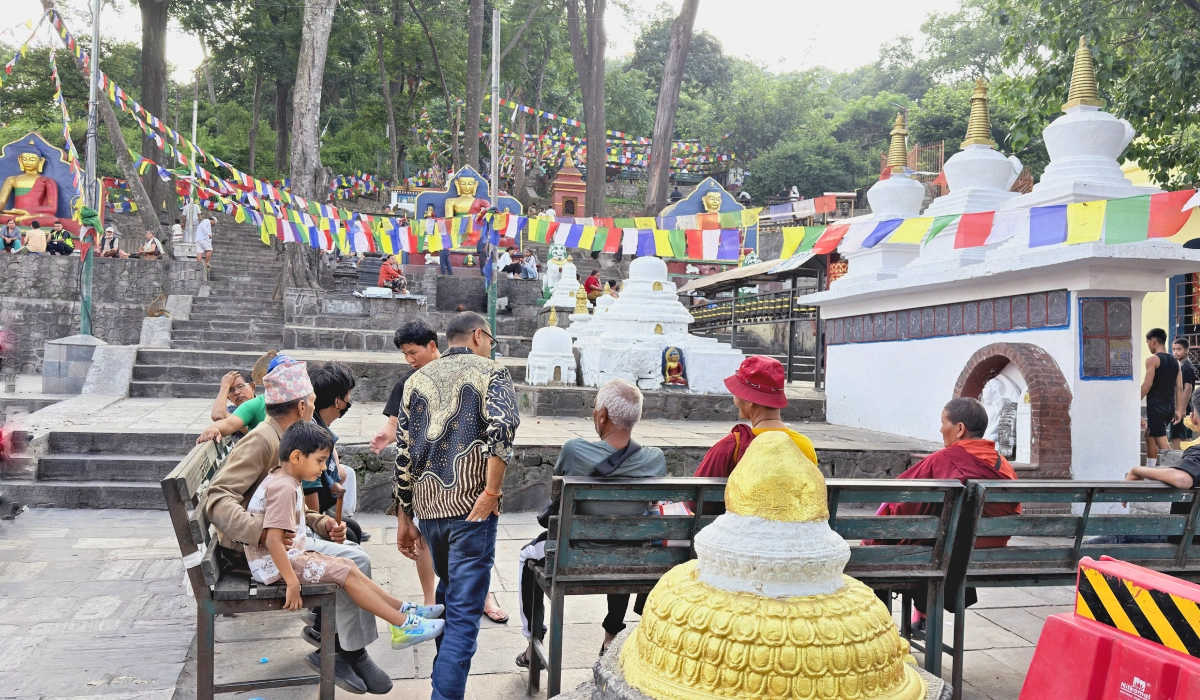
It is perched on a hill within Kathmandu Valley on its western side. The monkey temple distance is around 2-3 kilometers from Thamel, which is one of the most famous tourist places in the capital.
Being on a hill, it offers an excellent view of the entire city of Kathmandu and thus is one of the best observation points in Kathmandu. Visitors will see a sprawling cityscape, surrounding green hills, and even distant Himalayan peaks from its serene ambience.
Despite being close to the center of the town, its peaceful atmosphere separates it from the hustle and bustle of Kathmandu’s street life.
Getting There
By Taxi
It is a quick and efficient means of travel to Swayambhunath. A taxi from Thamel will take you to Swayambhunath within 10-15 minutes, depending on traffic. You can get off a taxi at the western entrance of Swayambhunath and save yourself the trouble of climbing up the hill.
By Foot
Walking to Swayambhunath from Thamel may be another means of reaching your destination. You would spend about 30-40 minutes walking through local towns, old houses, small shops and busy streets. You’ll get a chance to know more about locals and learn the culture and lifestyle of Kathmandu on your way.
By Public Transport
Public transport such as local buses and microbuses that run throughout Kathmandu, can drop you off at the bottom of the hill. After that, you’ll be required to climb the hill to reach the temple site. It is one of the most affordable means of getting there.
Note: We ensure smooth, stress-free, and well-organized experiences so you can simply enjoy the experience without worrying about travel details, navigation, or logistics.
Story Behind the Architecture of Swayambhunath
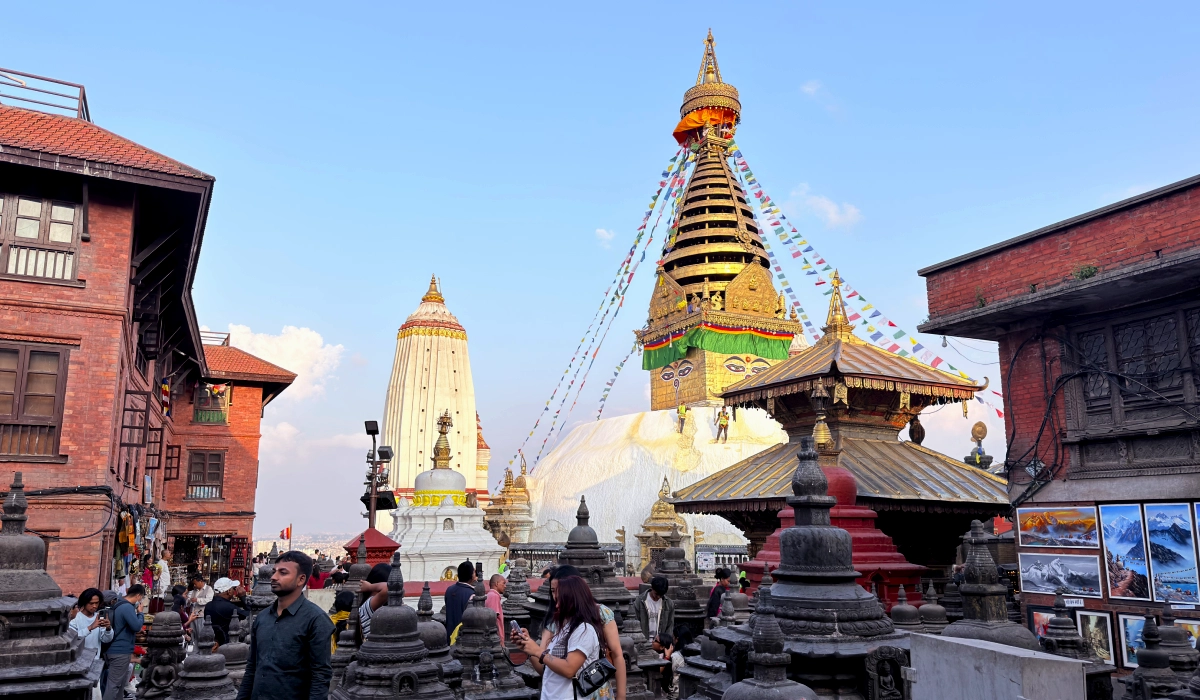
The Swayambhunath Stupa itself is the focal point of this complex. It is an impressive structure consisting of the white domed shrine crowned with a golden spire and Buddha’s eyes on all four sides. It is a great architectural wonder that is seen from various angles around the valley.
Each part of the stupa has a particular symbolism associated with it. The white dome signifies the earth element and is interpreted as a spiritual womb from where life originates; the color white signifies calmness and purity.
Likewise, the square shape on the top is the Harmika and signifies stability and the four directions. It is adorned with four eyes of Buddha looking in every direction, symbolizing awareness and wisdom.
Rising above is the spire with its 13 tiers, signifying the 13 stages to enlightenment: pinnacle/parasol. It denotes the process that a sentient being must pass through to achieve enlightenment or nirvana.
At the topmost level is the canopy or pinnacle that stands for the element air or void, representing spiritual elevation and attainment of enlightenment that lies above the physical world.
Besides the central Stupa, the complex has many religious and cultural monuments
Smaller stupas and shrines
- Prayer wheels with sacred mantras carved into them
- Buddhist monasteries and meditation sites
- Stone inscriptions and sculptures
- Shrines for Hindu gods
Best Time to Visit Nepal Swayambhunath Stupa
The Swayambhunath Monkey Temple in Kathmandu is rightfully regarded as one of the most recognizable and visited landmarks in Nepal. The temple can be explored all year round, but the most favorable times are spring and autumn.
Trip not found.
There will be a comfortable temperature range, nice weather, clear sky, and perfect visibility conditions. Besides, these seasons are best for photographing Swayambhunath as the surroundings look vibrant and scenic.
There are clear skies and perfect visibility in winter, but the weather tends to be cold, particularly in the mornings and evenings on top of the hill. Likewise, the rainy season or monsoon comes with a lot of rainfall, humidity, and poor visibility due to cloudy conditions, and the stone steps also get slippery.
At what hour is it best to visit the Swayambhunath Temple?
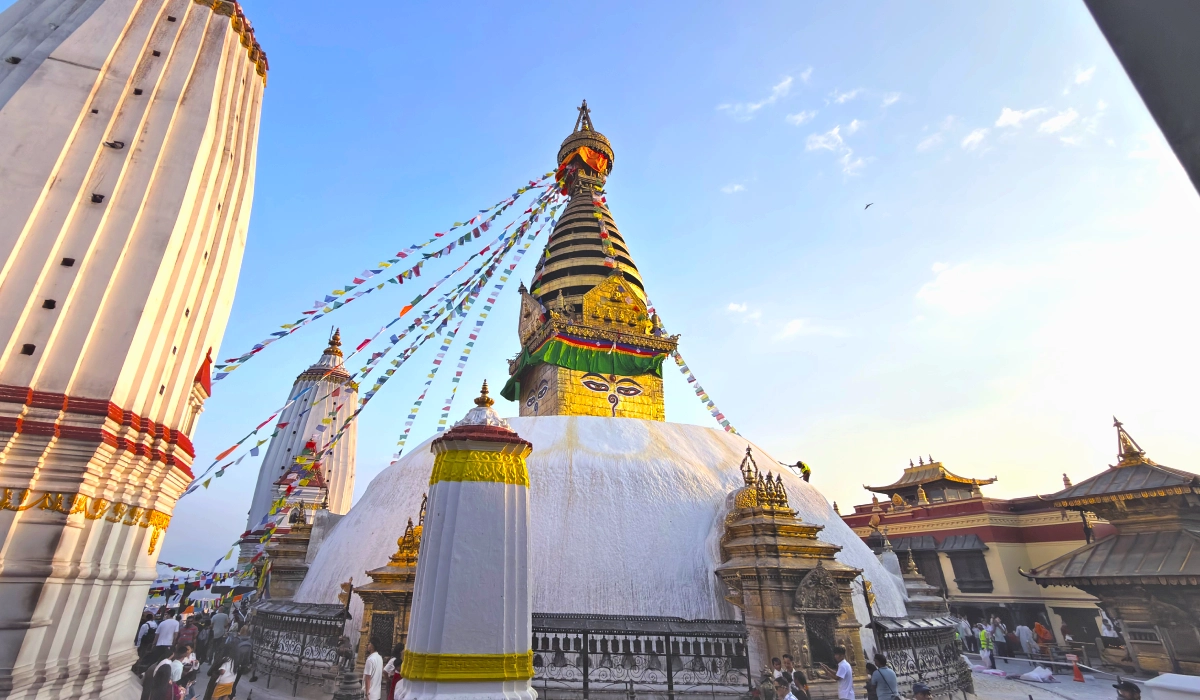
It is advisable to visit the stupa during early morning hours. As the first rays of the sun illuminate the city of Kathmandu, people start visiting the stupa for their prayers. Pilgrims and monks pray, turn prayer wheels, chant mantras, and light butter lamps. Early morning at Swayambhunath is characterized by fresh air, the sound of bells, and an overall peaceful atmosphere, which enhances the spiritual essence of the area
Similarly, the sunset period is also a very good choice for visiting the site. With the sun about to set, its rays fall on the white dome and golden spire of the stupa that gleams in the rays. The beautiful sunset view from the top excites photographers and travelers alike.
Those who wish to enjoy the culture of Nepal can also choose to visit during Buddhist festivals, at which the stupa is vibrant with religious ceremonies, colorful decorations, and large gatherings of devotees.
Entrance Fee and Opening Hours at Swayambhunath
The Swayambhunath Stupa in Kathmandu is usually open to visitors on all days from morning to evening, providing enough time to tour the stupa and other important attractions at the location. It is best to tour during daylight so as to ensure safe access up to the top of the hill and roam in its surroundings.
The entry fee is
- Foreign Tourists – NPR 200
- SAARC Nationals – NPR 50
- Nepali Citizens – Free
Note: The entry fee can change from time to time, and it is good to check the latest rates before planning a visit. Explore Vision Nepal manages ticket issuance and entry fees to ensure a hassle-free experience for you.
Visitor Tips for Visiting Swayambhunath Stupa, Kathmandu
- Always walk in the clockwise direction, a sacred act.
- Ask before taking photographs of monks and other people
- Remove shoes before entering meditation halls and main temples
- Don’t feed the monkeys, which will provoke them. Never takeout food, even for a snack.
- Carry your bags and loose belongings safely.
- Try not to make any provoking movements and stare at the eyes of the monkey.
Though they might seem to behave unpredictably, the importance of the presence of these monkeys cannot be overstated. They give a very distinctive character, energy, and a unique identity to the stupa.
Can Visitors Take Photographs Inside Swayambhunath?
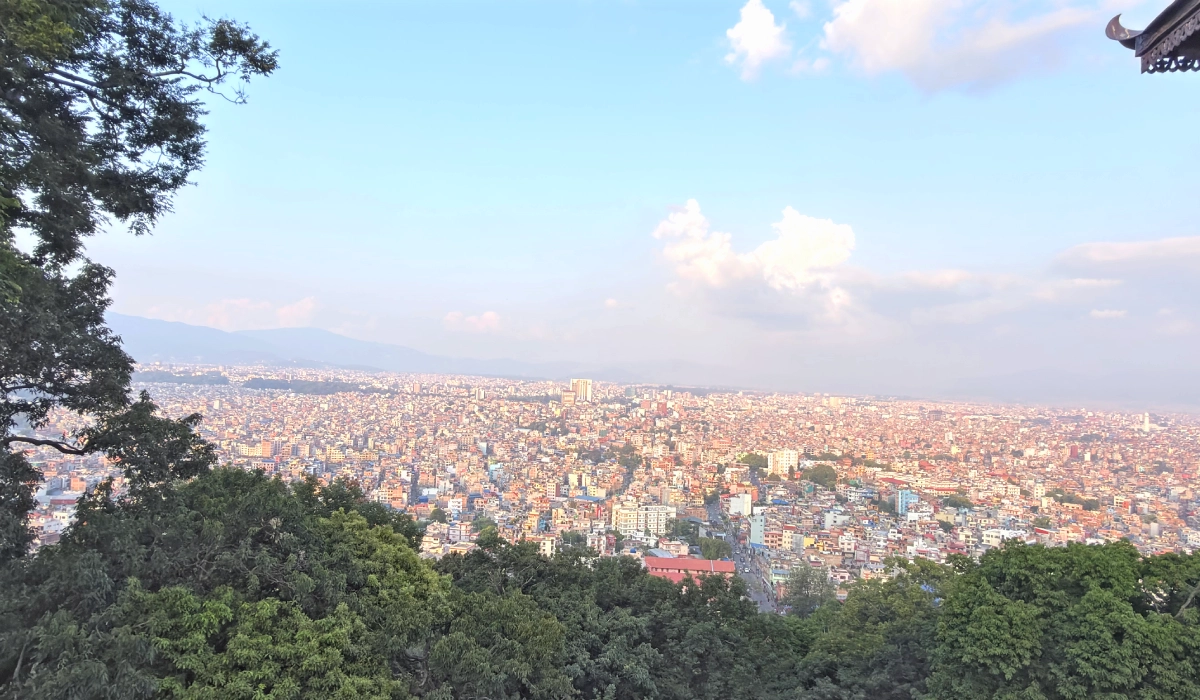
Visitors are usually permitted to take pictures inside the Swayambhunath Stupa. Almost all the areas, which include the stupa, shrines, prayer wheels, and viewing points, are accessible and widely preferred by people for taking pictures. You can also capture the panoramic view of Kathmandu Valley from there.
But remember, photography is not allowed within some shrines, including Hariti (Ajima) temple. So, check if there are “No Photography” warning boards. In case you are going to do commercial photography or filming, you might need to apply for the appropriate permit from the Ministry of Information and Communication (MoIC) prior to taking any pictures.
Besides, visitors should be respectful and careful while taking photos. They should refrain from using flash cameras within monasteries or while the religious ceremonies are going on. Moreover, you are not supposed to click the picture of monks or worshippers without seeking prior consent from them.
Why Swayambhunath Stupa also called Monkey Temple?
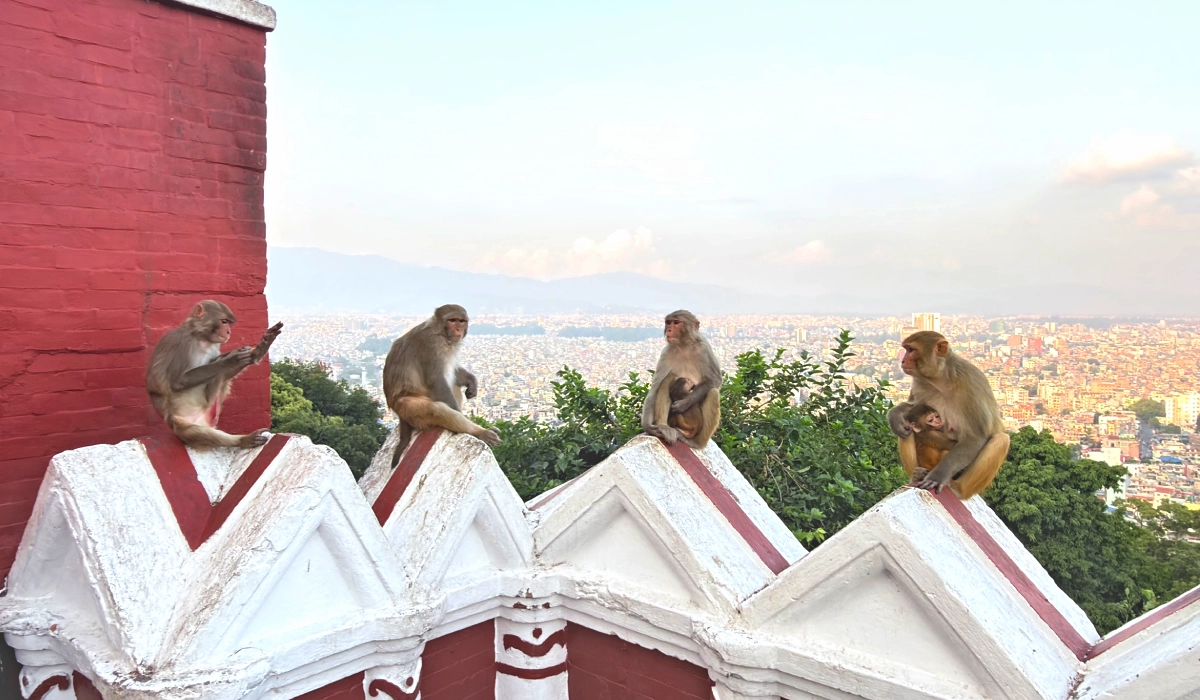
Swayambhunath Stupa is called the Monkey Temple Nepal due to the large population of monkeys freely inhabiting its forested hills. The monkeys are integral to the temple’s environment and constitute one of its unique aspects.
In local traditions, the monkeys are considered sacred protectors of the temple. In addition, they are extremely lively and intelligent creatures who display human behavior in many ways. They are:
- Extremely social animals living in large numbers
- Curious animals, particularly when it comes to food and the visitors’ belongings
Not to Do with Monkeys:
- Don’t feed the monkeys, which will provoke them.
- Carry your bags and loose belongings safely.
- Try not to make any rapid movements and stare at their eyes if they try to approach you.
Practical Tips for Visiting the Swayambhunath Stupa, Nepal
- Take some money for small offerings and donations
- Wear appropriate footwear suitable for climbing stairs and stony walkways
- Take some water for hydration purposes
- Wear sunglasses or a cap to protect from sunlight and dust particles
- Bring your camera for photography purposes
- Do not make noise around prayer places
- Do not touch any religious objects without prior permission
- Avoid feeding the monkeys recklessly
- Always give space for worshipers
Conclusion
Swayambhunath Temple is one of the most sacred spiritual and cultural landmarks of Nepal. As a living embodiment of ancient myths, age-old architecture, panoramic views, and religious beliefs, the temple offers visitors a unique understanding of the heritage of the country. If you have an interest in spirituality, culture, or photography, then you must visit Swayambhunath Temple.
Frequently Asked Questions (FAQs)
Is Swayambhunath Accessible to All?
Yes. Swayambhunath can be visited by people of all age groups. For elderly travelers or for people with some physical issues, the eastern steps might be difficult to negotiate. In that case, it is better to opt for the west entrance, as it can be accessed by vehicles and entails very little climbing.
How Much Time Does It Take To Explore Swayambhunath?
It takes 1 to 2 hours for most tourists to explore the Swayambhunath stupa and its surroundings. If you would like to make the most of your day across the Kathmandu Valley’s UNESCO sites of Nepal, including Swayambhunath Stupa, check out our Kathmandu Valley Day Tour.
Can You See The Himalayan Mountains From Swayambhunath?
Yes, visitors can have a bird’s eye view of the Kathmandu Valley and the Himalayan ranges on clear days. Visibility is especially high during the autumn and winter months.
Are There Any Restaurants Or Gift Shops Around Swayambhunath?
Yes. There are several hotels close to the stupa where you can find meals and drinks, as well as traditional handicraft stalls.
Can I Visit Patan And Bhaktapur On The Same Trip As Swayambhunath?
Absolutely, the most efficient way to explore these sites on the same trip as Swayambhunath is through a 2-day tour. Our specially designed itinerary, the Kathmandu, Patan, and Bhaktapur Tour, covers a complete exploration of Pashupatinath, Bouddhanath Stupa, Patan Durbar Square, and Bhaktapur Durbar Square