


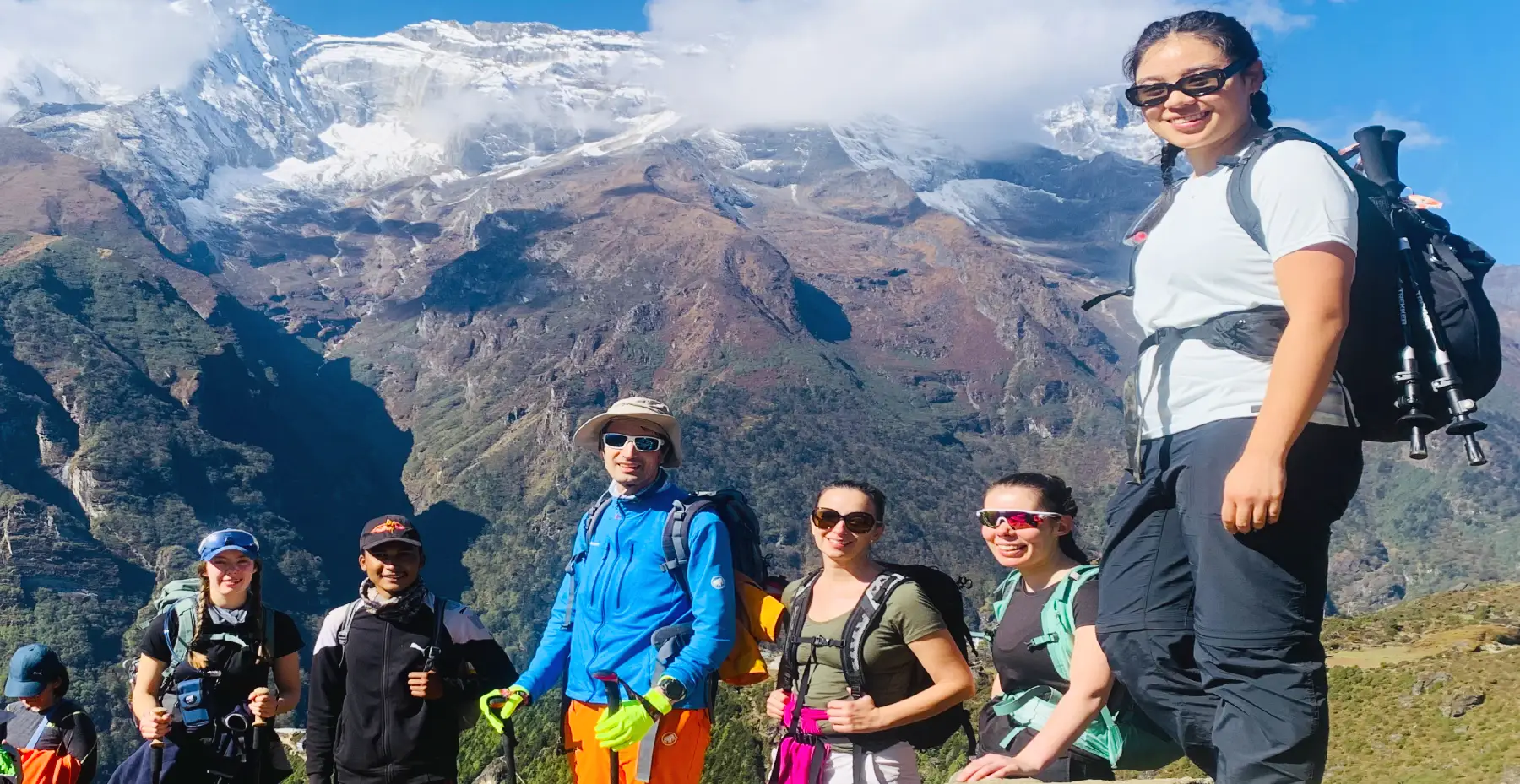

- Yes, beginners can complete EBC with basic fitness, a slow and steady pace, and a standard 12 to 14-day itinerary – no technical climbing skills or mountaineering experience required.
- Training matters more than natural athleticism. A structured 12-week plan focused on cardio endurance, downhill leg strength, and loaded-pack hikes makes the biggest difference in your success on the trail.
- Altitude, not distance, is the real challenge. Above 3,500 meters, your body needs time to adjust to lower oxygen levels, this is why proper acclimatization days matter more than raw fitness.
- A licensed guide and specific permits are required by law, including the Sagarmatha National Park Entry Permit and the Khumbu Pasang Lhamu Rural Municipality Permit.
- Daily life is simple but rustic – unheated teahouse rooms, shared bathrooms, and paid Wi-Fi and charging, so knowing what to expect prevents unnecessary surprises on the trail.
The idea of standing at the foot of the world’s highest mountain feels intimidating. Can a beginner go to Everest Base Camp? If you’re wondering whether you have what it takes to complete the Everest Base Camp Trek for beginners, the direct answer is: Yes. You do not need to be an elite athlete, and you absolutely do not need technical mountaineering experience. If you can commit to a structured physical training routine and respect the laws of high-altitude acclimatization, you can successfully reach Everest Base Camp (5,364 m).
However, do not mistake a lack of technical climbing for an easy holiday. The Everest Base Camp Trek difficulty stems from the cumulative toll of thin air, cold temperatures, and consecutive days of physical exertion in remote conditions. You will sleep in unheated local teahouses, walk five to seven hours a day, and experience the physical demands of high-altitude physiology.Everest Base Camp Trek for beginners
Every year, thousands of first-time trekkers stand at the Mount Everest Base Camp. Success comes down to two things: a disciplined physical training plan before you arrive in Nepal, and strict adherence to acclimatization protocols once you are on the mountain. Here is the definitive, field-tested reality of what to expect, how to train, and how to safely conquer the EBC trail.
Everest Base Camp at a Glance
- Destination: Khumbu Region, Sagarmatha National Park, Nepal
- EBC Elevation: 5,364 meters (17,598 ft)
- Highest Viewpoint: Kala Patthar at 5,545 meters (18,192 ft)
- Typical Duration: 12 to 14 days on the trail (plus Kathmandu buffer days)
- Difficulty: Moderate to challenging (non-technical, but physically demanding)
- Technical Climbing: None required
- Guide Regulations: Licensed guide required under 2026 Nepal Tourism Board provisions
- Accommodation: Local family-run teahouses
- Highest Sleeping Point: Gorak Shep (5,164 m)
- Best Seasons: Spring (March–May) and Autumn (Late Sept–Nov)

Everest Base Camp Trek – 14 Days
Everest Base Camp Trek is an iconic journey that follows in the footsteps of legendary mountaineers Sir Edmund Hillary and Tenzing Norgay Sherpa. It is done in eastern Nepal within the internationally recognized...
 14 Days
 Difficult
US$ 1440
Everest Trekking vs. Climbing: Clearing the Biggest Misconception
One of the most persistent misunderstandings in adventure travel is the conflation of trekking to Everest Base Camp (EBC) with climbing Mount Everest. When people hear “I’m going to Everest,” they often visualize technical ice axes, vertical walls, and extreme danger.
In our almost two decades of guiding experience in the Himalayas, the most common confusion we hear from foreign trekkers or beginners revolves around the difference between trekking to Everest Base Camp and climbing Mount Everest itself. Let us clear this up immediately.
When people ask, “Can a beginner climb Mount Everest? Or can beginners climb Everest? The answer is a definitive no. Climbing the actual summit of Mount Everest (8,848.86 meters / 29,032 feet) requires years of high-altitude alpine experience, specialized gear like crampons and ice axes, bottled oxygen, and a budget exceeding $45,000. It is a dangerous, technical expedition into the “Death Zone.”
But can you visit Everest Base Camp without climbing? Absolutely. The Mount Everest Base Camp Trek is a high-altitude hike, its not the technical expeditions.
- No Technical Gear: You will not use ropes, ladders, or ice axes. You only need sturdy, broken-in hiking boots and trekking poles.
- Glacier Crossings: No technical glacier climbing is required. However, the final route between Gorak Shep and Everest Base Camp crosses glacial terrain along the Khumbu Glacier’s lateral moraine. This terrain consists of loose rock, frozen dirt, and undulating ice where conditions can change rapidly, so careful footing is essential.
- No Tents Required: You sleep in established Sherpa villages in stone teahouse lodges every night.
Can a novice climb Everest? No, you cannot climb the summit. But Can anyone go to Everest Base Camp? Or Can a beginner go to Everest Base Camp? Yes, because you are not climbing it, you are walking to it. You are following the historic classic EBC routes used by Sherpas for generations and trekkers by decades. If you want to know how to hike to Everest Base Camp, it starts with understanding that this is a test of endurance and pacing, not a test of technical alpine skill.
How Do I Know If I’m fit enough for Everest Base Camp?
You do not need to be a marathon runner to succeed on this trail. Nor need to be a champion athlete.
“Mountain fitness” is primarily about aerobic endurance, joint durability, and recovery capacity.
The single best way to evaluate your current conditioning is by testing yourself against specific, real-world benchmarks before you depart.
- Hike 5 to 6 hours on hilly terrain (similar to Everest route if possible) without severe exhaustion.
- Handle consecutive active days (e.g., hiking on Saturday/Sunday, then waking up and hiking to the office).
- Carry a 5 to 7 kg daypack comfortably for 5 – 6 hours without lower back or shoulder spasms.
- Climb multiple flights of stairs at a steady pace without stopping constantly to catch your breath.
- Walk downhill for extended periods without significant knee pain (this requires eccentric leg strength).
- Recover well after long physical exertion, waking up the next day without debilitating muscle soreness.
If you cannot check these boxes yet, do not worry. That is exactly what a structured training plan is for.
The Definitive 12-Week Everest Base Camp Training Plan
If you are wondering can I do Everest Base Camp without training or basic hiking experience? The answer is no. If you are a complete beginner, a first-time trekker who hasn’t even hiked, the answer is no. You need to train to do EBC trek.
Attempting this trek off the couch guarantees misery, a high risk of injury, and a massive chance of altitude failure. You must build your cardiovascular engine and condition your legs for the continuous impact of downhill descents.
How to prepare for Mount Everest Base Camp Trek for a complete Beginner
The Everest Base Camp Trek for beginners always requires some practical training and preparation before starting the trek. This will help beginners complete the trek without serious problems and allow them to enjoy the trip (hike). Your training must focus on three pillars: Aerobic base building (Zone 2 cardio), eccentric leg strength (downhill braking), and progressive load bearing (hiking with a backpack).
Three Core Training Pillars for Everest Base Camp Trek for beginners
1. Cardiovascular Endurance (The Aerobic Base)
According to our experienced guides at Explore Vision Nepal
Your lungs and heart must become incredibly efficient at delivering oxygen to your muscles. Do not focus on high-intensity sprinting. Focus on long, sustained, low-intensity cardio often called “Zone 2” training.
The best exercises are incline treadmill walking, stair-climber machines, cycling, or swimming.
2. The Secret Weapon: Eccentric Leg Strength
Explore Vision Nepal emphasizes focused strength sessions to prepare your lower body for thousands of ascending and descending steps.
‘Heavy weights are unnecessary, consistency and stability are the goals.’
Practice single-leg step-downs. Stand on a small box or stair step, and slowly lower one heel to the floor over three to four seconds, keeping your working knee tracking over your toes.
Explode back up. This builds the specific knee-stabilizing muscles you need for the rocky Khumbu descents. Add Bulgarian split squats, walking lunges, and calf raises to your routine.
3. Trail Simulation (The Loaded Daypack)
You will not carry your heavy duffel or main trekking bag, a local porter on our team handles that.
However, you must carry your own daypack containing water, layers, cameras, and snack, usually weighing 5 to 8 kilograms (Some trekkers hire a private porter to carry small day packs; this is optional, and we will coordinate to arrange a private porter upon your request). Do your practice hikes wearing the exact trekking boots you will wear in Nepal to break them in completely.
The 12-Week Schedule for Beginner Trekkers before EBC Trek
| Week | Cardio (Zone 2) | Strength / Eccentric Work | Long Trail Hike (Loaded Pack) |
| Weeks 1–2 | 3 days × 30–40 min | 2 days (Squats, lunges, core) | 1 day × 2–3 hours (3 kg pack) |
| Weeks 3–4 | 3 days × 45 min | 2 days (Add step-downs) | 1 day × 3 hours (4 kg pack) |
| Weeks 5–6 | 4 days × 45 min | 2 days (Weighted step-ups) | 1 day × 3–4 hours (5 kg pack) |
| Weeks 7–8 | 4 days × 50 min | 2 days (Calf raises, deadlifts) | 1 day × 4–5 hours (6 kg pack) |
| Weeks 9–10 | 4 days × 60 min | 2 days (Full leg & core circuits) | 1 day × 5–6 hours (7 kg pack)* |
| Week 11 | 3 days × moderate pace | 2 days (Light mobility only) | 1 day × 4–5 hours (6 kg pack) |
| Week 12 | Taper: 2 days easy walks | Taper: Stretching / Yoga | Rest, hydrate, and prepare for travel |
*By Weeks 9 and 10, try to schedule “back-to-back” hikes (e.g., 4-5 hours on Saturday, 3-4 hours on Sunday) to simulate consecutive trail fatigue.
The Altitude Factor & Medical Safety
Physical training gets you to the mountain, altitude management gets you to Base Camp. When beginners ask how hard is it to get to Everest Base Camp? They are usually underestimating the biological toll of the Everest Base Camp elevation.
A dangerous misconception is that the air at Everest Base Camp has “50% less oxygen.” Technically, the atmospheric fraction of oxygen remains constant at roughly 21% everywhere on Earth. However, barometric pressure falls substantially with altitude. At 5,364 meters, the barometric pressure is roughly half that of sea level, meaning the oxygen partial pressure drops. Every breath delivers significantly fewer oxygen molecules to your bloodstream.

Everest Base Camp Trek with Helicopter Return to Lukla – 12 Days
Everest Base Camp Trek with Helicopter Return to Lukla is an adventure journey in the Khumbu region designed for trekkers who want to experience the classic EBC journey while saving valuable time. Spanning...
12 Days
Difficult
US$ 2100
How Acclimatization Actually Works
Acclimatization is a complex physiological cascade. First, your body hyperventilates (breathing deeper and faster) to draw in more oxygen. This blows off excess carbon dioxide, altering your blood’s pH balance (respiratory alkalosis). Your kidneys then work to excrete bicarbonate in your urine to restore acidity. Over days and weeks, your kidneys stimulate the release of erythropoietin (EPO), which eventually ramps up red blood cell production.
This process takes time. You cannot rush it. This is why every safe itinerary includes mandatory rest days at Namche Bazaar (3,440 m) and Dingboche (4,410 m) for EBC trek journey. Our standard 14-day Everest Base Camp Trek itinerary includes acclimatization days at both places.
Identifying Altitude Sickness
It is normal to experience mild breathlessness on exertion, a slight headache, and disrupted sleep as you ascend above 3,500 meters. However, you must communicate honestly with your team and guide, who will use the ‘Lake Louise Score’ (A standardized system used to monitor and assess symptoms of altitude sickness) (AMS) during high-altitude trekking) to evaluate your condition.
Acute Mountain Sickness (AMS) Warning Signs:
- A persistent, throbbing headache that does not respond to standard painkillers.
- Loss of appetite, nausea, vomiting, or profound fatigue.
Action: Halt your ascent, Rest. If symptoms worsen, you must descend.
Emergency Symptoms (HAPE & HACE):
If AMS is ignored, it can progress to High-Altitude Pulmonary Edema (HAPE) or High-Altitude Cerebral Edema (HACE).
- HAPE (Fluid in the lungs): Extreme breathlessness at rest, a persistent rattling chest cough, reduced exercise tolerance, and potentially pink or frothy sputum.
- HACE (Brain swelling): Severe confusion, altered mental status, extreme lethargy, and ataxia (loss of physical coordination; walking as if intoxicated).
Action: Immediate, unmistakable priority to descend. Administer supplemental oxygen if available, and coordinate an emergency helicopter evacuation.
Safe Hydration Protocol
Hydration protocols are very important for beginners on the Everest Base Camp Trek. Drink regularly throughout the day to replace fluids lost through exertion and heavy respiration in the dry mountain air. Avoid both dehydration (which mimics and exacerbates altitude sickness) and excessive water intake (which can lead to dangerous hyponatremia). Let your thirst and urine color (aiming for pale yellow) be your guide. Carry water purification tablets or a filter system, as buying bottled water on the trail creates unnecessary plastic waste and becomes very expensive.
2026/2027 Trail Regulations: Guides and Permits
Recent updates from the Nepal Tourism Board and local Khumbu authorities have changed the logistics of trekking in the Everest region.
If you are asking can you go to Everest Base Camp without a guide? Or searching for Everest Base Camp Trek without guide, you must understand the current legal landscape.
1. A Licensed Guide is Mandatory
Under Nepal Tourism Board’s revised provisions, foreign trekkers exploring standard itineraries must be accompanied by a licensed trekking guide. While the Khumbu local municipality has occasionally debated national rules in the past, effectively all legitimate trekking checkpoints, national park gates, and insurance providers enforce the guided requirement for standard treks to ensure immediate emergency response, altitude monitoring, and safe navigation.
However, the mandatory licensed trekking guide rule is not being properly implemented or followed by international trekkers in the Everest trekking region. Currently, independent trekkers are exploring the Everest Base Camp Trek and other trekking destinations in the Everest region without a guide or porter, and also without joining local agencies
For a beginner, a guide is an absolute safety necessity, not an optional luxury.
2. The Permit Structure & 2026/2027 Costs
You need two specific permits to legally hike on the EBC route. Note that the TIMS (Trekkers’ Information Management System) card is not required in the Khumbu region, it was superseded by the local Khumbu Pasang Lhamu Rural Municipality Permit.
On the other hand, the Nepal Tourism Board lists the Everest region, including the Everest Base Camp Trek, as requiring TIMS under the ‘Revised TIMS Provision,’ effective from March 31, 2023. However, they have not officially declared that trekkers don’t need TIMS for trekking in the Everest region of Nepal. In practice, though, trekkers have been exploring trekking destinations in the Everest region without TIMS in recent times, at least as of September 2026.
- Sagarmatha National Park Entry Permit: NPR 3,000 (approx. $21 USD) per foreign trekker. This fee funds environmental conservation and park maintenance.
- Khumbu Pasang Lhamu Rural Municipality Permit: NPR 3,000 (approx. $21 USD). This is the local entry fee, which was raised from NPR 2,000 to NPR 3,000 in recent updates.
A registered trekking agency such as Explore Vision Nepal will organize both of these required documents for you in Kathmandu and Lukla, eliminating any administrative stress on the trail. Furthermore, as of recent regulations, proof of valid travel insurance covering helicopter rescue is a strict prerequisite for obtaining these permits.
3. A Critical Note on Travel Insurance
Never imply or assume a standard travel policy covers Himalayan trekking. Check that your specific policy explicitly covers non-technical trekking at your maximum planned altitude (up to 6,000 meters) and unscheduled emergency medical helicopter evacuation.
Daily Life on the EBC Trekking Trail: Expectations vs. Reality
The rhythm of daily life on the Everest Base Camp (EBC) trail is beautifully simple, yet it often catches first-time trekkers by surprise. The glossy brochures present a flawless journey of epic mountain vistas, but the day-to-day reality involves a unique blend of high-altitude grit, rustic hospitality, and unforeseen challenges.
Knowing what to expect from the daily routine prevents culture shock and mental fatigue.
Teahouse Accommodations
Teahouse/Guesthouse/Lodge are the backbone while trekking in Nepal Himalayas. You will sleep in family-run or some business base stone lodges known as teahouses. Rooms are basic, unheated, and typically feature two twin beds with foam mattresses and a thin blanket (However, better and upgraded accommodations are available these days, mainly at Lukla, Phakding and Namche Bazaar). Above 4,000 meters (like in Lobuche or Gorak Shep), the ambient temperature inside your room will plunge below freezing at night.
Water in your bottle will turn to ice, that means, the higher located places will be very cold. A high-quality, 4-season down sleeping bag (rated to -15°C) is absolutely mandatory. You can rent these cheaply in Kathmandu, or at Explore Vision Nepal, we provides -20°C down jackets for our clients.
Bathrooms are shared.
At lower elevations, you will find Western flush toilets. At higher elevations, expect traditional Asian squat toilets and a bucket of icy water for flushing.
The “Meat Rule” & Trail Food
The teahouse menus are surprisingly diverse, offering pasta, fried rice, oatmeal, pancakes, and the legendary Dal Bhat (steamed rice, lentil soup, and vegetable curry). Dal Bhat is fantastic trail fuel because it is carbohydrate-dense and teahouse owners provide free refills.
Regarding meat: Many trekkers and guides choose vegetarian meals at higher elevations because refrigeration and food transportation (carried up over several days by porters) become much more challenging past Namche Bazaar. If you do choose to eat meat, ensure you select well-cooked dishes from reputable lodges, and use your own judgment to prevent foodborne illness.
Showers, Wi-Fi, and Charging
Modern conveniences exist on the trail, but you must pay out-of-pocket for them.
- Showers: Gas-heated showers are available in lower to middle villages for $3 to $5. Above 4,000 meters, it is best to avoid showering altogether to prevent catching a cold in the freezing air. Rely on wet wipes and a change of dry clothes.
- Charging: You can charge your devices in the dining hall, but teahouses charge by the hour or by the full battery. Bring a high-capacity power bank. Keep your phone and batteries inside your sleeping bag at night so the cold doesn’t drain them.
- Connectivity: You can purchase Wi-Fi data cards (like Everest Link or AirLink) at most lodges for $5 to $10. The connection is passable but sufficient for basic messaging and keep in touch.

Luxury Everest Base Camp Heli Trek
The Luxury Everest Base Camp Heli Trek is one of the most well-known trekking journeys in Nepal’s Khumbu Himalayan region. Luxury Everest Trek follows the same trail every Everest Base Camp trekker takes,...
12 Days
Moderate
US$ 4100
Frequently Asked Questions
How Long Does It Take To Trek Mount Everest Base Camp?
A safe, properly acclimatized trekking itinerary takes 12 to 14 days on the trail to reach Everest Base Camp. Attempting to rush the trek in 9 or 10 days drastically increases your chances of severe altitude sickness. You must also factor in a few buffer days in Kathmandu, as flights to Lukla are frequently delayed by Kathmandu weather and mountain cloud cover.
What Is The Temperature At The Top Of Mount Everest Vs. Base Camp?
While the summit of Everest can drop to -60°C (-76°F), the temperatures at Base Camp are much more manageable for trekkers. During the peak trekking seasons (Spring and Autumn), daytime temperatures at Base Camp can range from 5°C to 12°C (41°F to 53°F) in the sun, dropping to -10°C to -15°C (14°F to 5°F) at night and changing weather conditions.
Is It Safe To Trek To Everest Base Camp?
Yes. When you trek with a reputable agency, follow a slow acclimatization schedule, listen to your guide regarding your health, and carry proper high-altitude travel insurance, the trip to Everest Base Camp is incredibly safe. The infrastructure for trekkers is world-class, and emergency medical support is readily available if needed.
How Steep Is The Mount Everest Trail?
The trail is not a continuous, vertical stair-climb. It is a series of rolling ascents and descents. There are a few notoriously steep sections such as the climb up to Namche Bazaar, the ascent out of the river valley to Tengboche, and the rocky push up the Thokla Pass. However, there are also long stretches of relatively flat, gradual walking through beautiful alpine valleys.
Ready for Everest Base Camp?
You now understand the physical requirements, the altitude reality, and the logistics. The bridge between reading about Everest and actually standing beneath it is booking a structurally sound, acclimatization-focused itinerary.
At Explore Vision Nepal, our standard Everest Base Camp Trek – 14 Day itinerary is designed specifically to maximize beginner success rates. We do not cut corners on acclimatization, and we treat our local guides and porters with the utmost respect.
We have also created 16- and 17-day Everest Base Camp Trek itineraries that are best for families, friends, and first-time trekkers. And even a customized trekking options for any trek.
Our standard EBC itinerary includes:
- 14 Days on the trail including Kathmandu, with guaranteed Lukla flight coordination.
- Licensed Guide: A highly experienced, English-speaking Sherpa/local guide carrying a pulse oximeter and comprehensive first-aid kit.
- Porter Support: Dedicated porter support so you only carry your light daypack.
- Acclimatization: Two critical acclimatization rest days (Namche Bazaar and Dingboche) to ensure your altitude safety.
- Accommodations & Meals: Pre-arranged, verified teahouse accommodations and three daily meals.
- Permits: All mandatory 2026/2027 national park and municipal permits for Everest trek handled for you.